Why Cloud Gaming Feels Like Magic
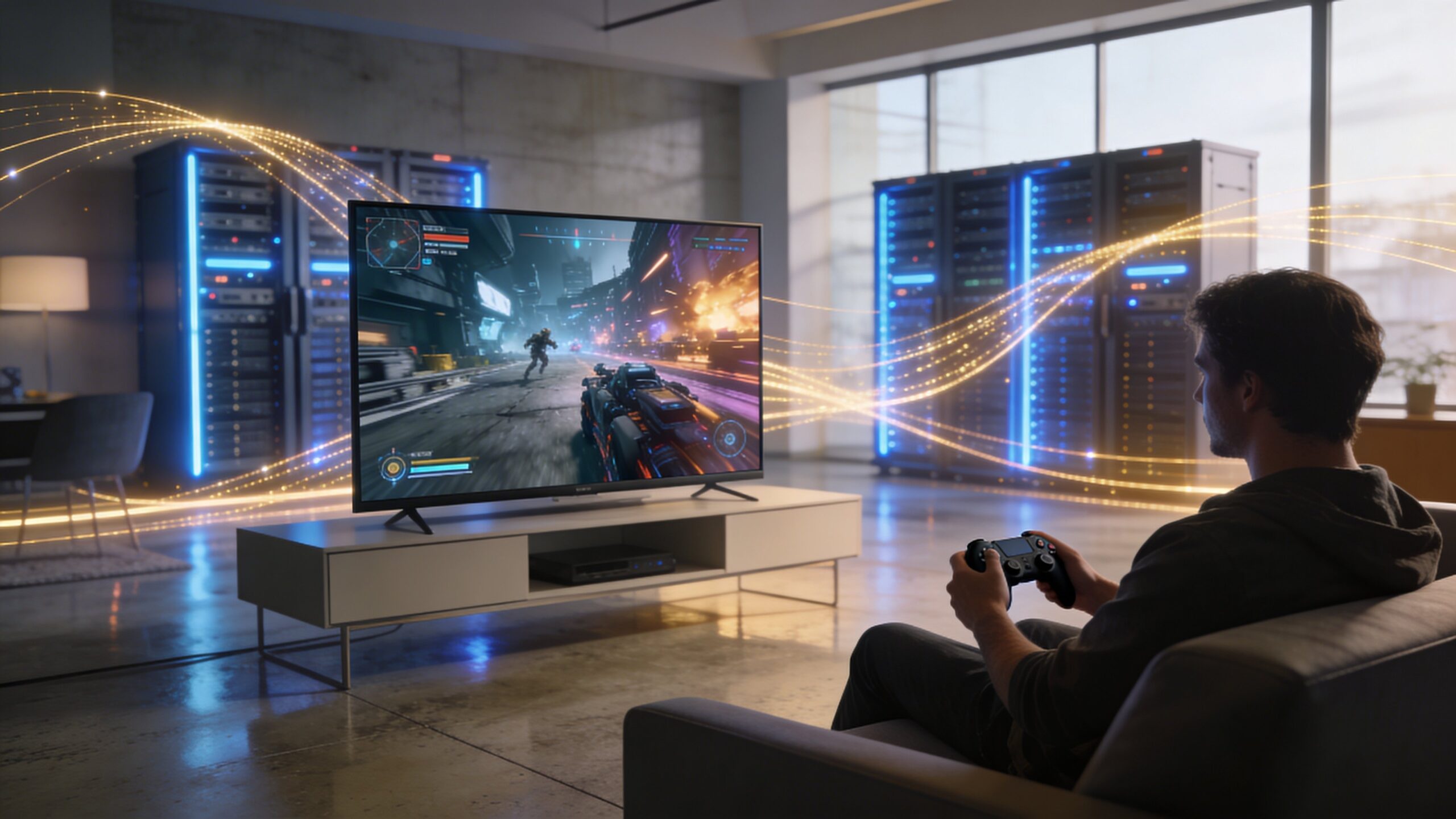
Cloud gaming can seem like one of those modern inventions that should not work, and yet somehow does. You press a button on a controller in your living room, and a game appears almost instantly on your TV, laptop, tablet, or phone. There is no giant console humming beneath the screen, no expensive graphics card tucked inside a computer tower, and no giant game file taking forever to download. It feels as if the game is floating through the air, arriving out of nowhere, ready to play. But cloud gaming is not really magic. It is a very fast and very clever system of computers, internet connections, data centers, and software working together behind the scenes. The easiest way to understand it is to imagine that the game is not actually living inside your device at all. Instead, the game is running somewhere else on a super-powerful computer far away. Your screen is simply showing you what that distant computer is doing, almost like watching a live video feed that responds to every button you press. When you move a character, jump over a wall, or swing a sword, that command travels to the remote machine. The remote machine reacts, creates the next frame of the game, and sends it right back to you. That is the heart of cloud gaming infrastructure. It is the giant invisible machine behind the experience. To a child, you might explain it like this: imagine your toy box is not in your room. Imagine it is in a giant playroom across town filled with every toy you could ever want. Whenever you ask for one, a super-fast helper uses it for you and shows you the results through a magic window. Cloud gaming works in a similar way. Your device becomes the window, while the real heavy lifting happens somewhere else.
A: No. In cloud gaming, the game runs remotely and streams to your screen live.
A: Because your device must constantly send inputs and receive video in real time.
A: It is the delay between pressing a button and seeing the game respond.
A: Usually no. Many services work on TVs, browsers, tablets, phones, and laptops.
A: Shorter distance usually means faster response and smoother play.
A: It can look impressive, but stream quality depends on bandwidth and compression.
A: Fast reaction games are more sensitive to delay than slower, less twitchy titles.
A: Yes. It still needs to decode the video stream well and send inputs quickly.
A: Smart platform software should redirect or rebalance sessions across available resources.
A: A faraway super-computer plays the game for you and sends the action to your screen.
The Big Computer Playground
At the center of cloud gaming infrastructure are data centers. These are large buildings filled with racks of powerful computers. Instead of one home console handling one player, these data centers contain thousands of machines that can run games for many people at once. Each machine may have strong processors, advanced graphics hardware, fast memory, and huge storage systems built to load game worlds quickly. Think of a data center as a giant digital arcade in the sky, except it is not actually in the sky and it does not have bright carpets or noisy prize machines. It is a serious, highly organized place where computers are kept cool, connected, and ready to work. These machines are designed to do what your own laptop or phone may struggle to do on its own. That is why cloud gaming can let someone play a visually demanding game on a simpler device. The game itself is not limited by the small gadget in your hands. It is powered by the distant machine doing the hard work for you. These data centers also need to be spread across many regions. If all cloud gaming servers lived in one city, players far away would suffer long delays. Their button presses would take too long to travel. So companies place servers in multiple locations to get them closer to players. The closer the server is to you, the faster the game can respond. In cloud gaming, closeness matters a lot. The system is always chasing speed.
How Your Button Press Travels
Every time you play a game, you are constantly sending instructions. Move left. Turn right. Jump. Run. Pause. Open inventory. Aim. Fire. Those commands leave your controller, keyboard, touchscreen, or mouse and travel through your internet connection to the remote gaming server. Once the server receives your input, it processes what happened inside the game. Maybe your character opened a door. Maybe your car drifted around a corner. Maybe your soccer player kicked the ball into the net. The server then creates the new image showing that result and compresses it into a video stream. That video stream travels back through the internet to your device, where you see it almost instantly.
This back-and-forth happens again and again, many times every second. It is a loop of input, processing, rendering, compressing, sending, receiving, and displaying. If even one part of that chain is slow, the whole experience can feel mushy. That is why cloud gaming infrastructure has to be incredibly efficient. It is not enough to have strong computers. The entire system must move information quickly and predictably. To explain it like you are five, imagine drawing with a friend who lives far away. You tell them what color crayon to use. They color the picture and instantly hold it up to a camera so you can see it. Then you tell them what to do next. If the line is very fast, the game feels smooth. If the line is slow, it feels like shouting directions through a storm.
Why Speed Matters So Much
Cloud gaming lives and dies by latency. Latency is the small delay between your action and the result appearing on screen. In a traditional game console sitting under your TV, the delay can be tiny because everything happens in one place. In cloud gaming, your command has to leave your home, travel across networks, reach a server, get processed, and come back again. Even when this happens quickly, it is still a longer journey. That is why cloud gaming companies fight so hard to reduce every possible millisecond. They place servers near large groups of users. They optimize how inputs are sent. They improve video compression so images travel faster. They design systems that react quickly to changing network conditions. In some cases, they even try to predict likely player actions so the experience feels smoother.
For young kids, latency might be explained as the time it takes for a game to “listen.” A game that listens fast feels smart and alive. A game that listens slowly feels sleepy. Racing games, fighting games, and shooters need very fast listening because even tiny delays can ruin the fun. Slower-paced strategy games or story adventures may tolerate more delay, but fast action titles demand speed. This is why people often say internet quality matters more in cloud gaming than in traditional gaming. You are no longer just downloading updates or playing online with friends. Your internet connection has become part of the console itself.
Streaming the Game Like a Movie That You Control
One reason cloud gaming is easy to compare to video streaming is that both involve sending pictures over the internet. When you watch a movie online, a server sends video to your screen. With cloud gaming, the server also sends video to your screen. The difference is that a movie does not care what you press on your controller, while a game must react immediately to every choice you make. That makes cloud gaming much harder than ordinary streaming. A movie can buffer ahead because it already knows what happens next. A cloud game cannot fully do that because it depends on you. The server must wait to see what you do, then build the next moment of the game around your actions. It is more like improvising a movie in real time than simply pressing play.
To make this possible, cloud gaming platforms use specialized encoding technology. After the server renders the game frame, it compresses that frame into a video signal that can travel efficiently across the internet. Your device then decodes that stream and shows it on your display. All of this has to happen extremely quickly. High-quality visuals are important, but responsiveness is even more important. A beautiful stream that reacts too slowly is worse than a slightly softer stream that feels immediate. That is why cloud gaming infrastructure balances image quality, frame rate, bitrate, and stability. Companies must decide how sharp the picture should be, how many frames per second they can maintain, and how much data they can send without overwhelming the user’s network.
The Hidden Helpers Behind the Curtain
A cloud gaming platform is not just a pile of gaming PCs in a warehouse. It also needs orchestration software, network management, load balancing, account systems, security, storage services, and game delivery tools. These systems decide which server should handle your session, how your saved progress is stored, and what happens if one machine fails. Imagine entering a giant amusement park with thousands of visitors. There must be workers directing people to the right rides, checking tickets, managing lines, and keeping everything safe. Cloud gaming works the same way. The powerful gaming hardware is only one part of the experience. There also has to be a smart system coordinating the whole operation.
Load balancing is especially important. If too many people want to play the same game in the same region, the system must spread that demand across available resources. If a server becomes overloaded or breaks, another machine should step in quickly. Reliability matters because players expect instant access. Nobody wants to be told the cloud is full. Storage systems are also crucial. Games are huge, and cloud platforms need fast access to them. Player profiles, saved games, preferences, and downloadable content must all be stored and retrieved efficiently. The infrastructure must remember who you are and where you left off, no matter what device you use to sign in next.
Why Your Device Still Matters a Little
Cloud gaming reduces the need for powerful local hardware, but it does not make your device completely irrelevant. Your phone, TV, browser, tablet, or laptop still needs to decode the incoming video stream, display it smoothly, and send your inputs quickly. A weak or outdated device might struggle with video decoding, especially at higher resolutions or frame rates. Your device also shapes how the experience feels. A smart TV app may feel different from playing in a browser. A wired controller may feel snappier than a touch screen. A phone connected to a stable home Wi-Fi network may perform better than one jumping between mobile signals. So while the server does most of the hard labor, your screen-side setup still matters. The best way to think about it is this: in cloud gaming, your device stops being the engine and becomes more like the steering wheel and windshield. It does not power the whole car, but it still affects the ride.
The Problem of Distance and Internet Traffic
One of the greatest challenges in cloud gaming is the simple fact that information cannot travel instantly. Even with advanced networks, distance introduces delay. Network traffic also changes throughout the day. A crowded internet route can make a once-smooth game feel uneven. Packet loss, jitter, and congestion can all interfere with responsiveness. This is why cloud gaming is strongest when the network path is short, stable, and fast. Wired connections often feel better than wireless ones. Strong Wi-Fi usually beats weak Wi-Fi. Fiber internet often performs better than older connections. The infrastructure on the company side can be excellent, but if the path to your home is bumpy, the experience suffers.
For children, this can be explained by comparing it to tossing a ball. If your friend is standing nearby, the ball gets there quickly. If they are far away, it takes longer. If a crowd steps in between you, the ball might slow down or get knocked off course. Cloud gaming infrastructure is always trying to keep that ball moving smoothly.
Why Companies Invest So Much in It
Cloud gaming has attracted attention because it promises a more flexible future for games. It can lower the cost of entry for players who do not want to buy expensive hardware. It can make games easier to access across different screens. It can allow instant play without long downloads or installations. It can also help publishers reach more people in more places. For companies, strong cloud gaming infrastructure is not just about technology. It is about convenience, access, and ecosystem growth. If a player can click and start immediately, that removes friction. If a game works across phone, TV, tablet, and laptop, that increases reach. If saved progress follows the user everywhere, that encourages loyalty.
Still, cloud gaming infrastructure is expensive to build and maintain. Data centers cost money. Powerful GPUs cost money. Bandwidth costs money. Cooling costs money. Engineering costs money. So the dream of cloud gaming is simple for the player, but behind the curtain it is one of the most demanding systems in modern entertainment.
What the Future Could Look Like
As internet speeds improve and servers get smarter, cloud gaming infrastructure may become more common and more capable. Lower latency, sharper images, better compression, and wider device support could make the experience feel closer to local gaming. Newer network technologies may reduce delay. Edge computing may place servers even closer to users. AI tools may help optimize video delivery and session management.
But even as the technology improves, the core idea stays the same. A powerful machine somewhere else runs the game. Your screen becomes the place where you see it, and your inputs become the instructions guiding it. The cloud is not replacing games. It is changing where the game machine lives. That makes cloud gaming infrastructure easier to understand than it first appears. It is a remote playground powered by big computers, fast internet, smart software, and constant communication. It is a system designed to make distance feel invisible. When it works well, it feels effortless. When it works badly, you suddenly notice every missing piece.
The Simple Way to Remember It
If you want the easiest possible explanation, here it is. Cloud gaming infrastructure is a faraway super-console that plays the game for you and sends the picture to your screen while listening to every button you press. The closer, faster, and smarter that system is, the better your game feels. That simple idea contains an enormous world of engineering. Data centers, servers, graphics processors, networking equipment, video encoders, storage systems, account services, and software orchestration all have to cooperate in real time. The whole system is built around one goal: making a distant game feel like it is right in front of you. So the next time someone says cloud gaming sounds impossible, you can smile and explain it like they are five. The game is not in your device. The game is in a giant digital playroom somewhere else. Your screen is just the magic window.