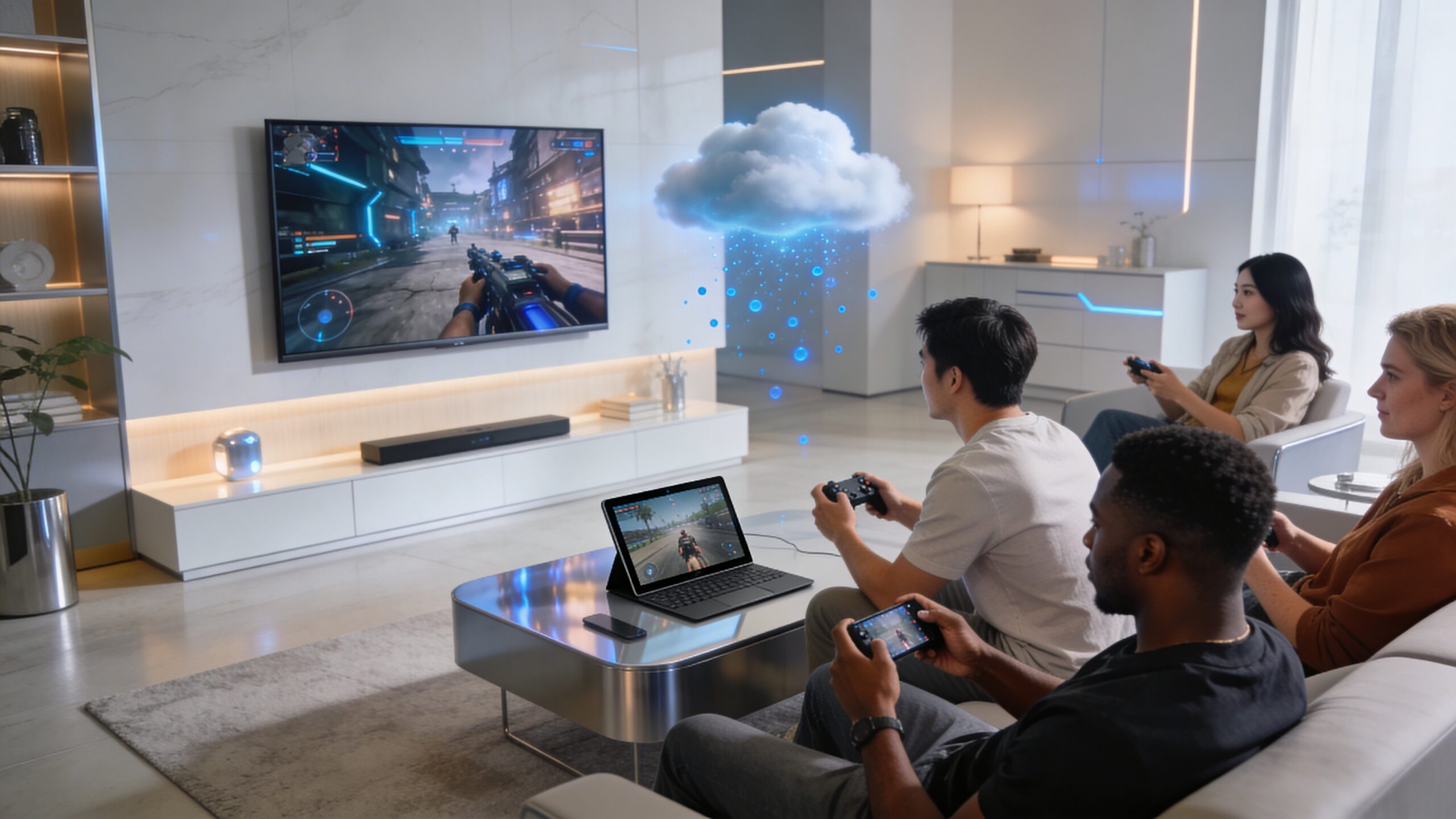
Cloud gaming has always sounded like a magic trick: press play on a cheap device, and a high-end rig appears somewhere far away to run the game for you. The promise is seductive—no downloads, no giant patches, no $600 console refresh every few years. But the reality has often felt like a compromise. A tiny delay in a parry window, a smear of compression in a dark corridor, a stutter when the network hiccups—those little frictions add up, and local play still holds the “tight” feeling that players trust. Now AI is changing the argument. Not just with smarter NPCs or prettier textures, but with techniques that can actively fight the weaknesses of streaming: prediction, reconstruction, adaptation, and optimization. AI can anticipate what you’re about to do, rebuild detail that the stream can’t afford to send, and re-route compute and bandwidth like a stage manager moving spotlights before the audience notices. The big question isn’t whether AI will improve cloud gaming. It will. The question is whether AI can make cloud games better than local games in a way you can feel—better responsiveness, better visuals-per-bit, better matchmaking, better accessibility, better performance consistency—without the cloud’s old penalties. To answer that, we need to define “better” honestly. Local games win on immediacy: your inputs go straight to hardware a few feet away, and the output is crisp and reliable. Cloud games win on convenience and scale: high-end compute on demand, instant access, and device freedom. AI is the lever that can push cloud gaming beyond “good enough” into “why would I buy hardware for this?” territory—but only if it’s used as an invisible craft, not as a marketing sticker.
A: Usually hybrid—some logic runs locally for speed, some runs on servers for stronger modeling.
A: Ideally it improves fairness and learning, not outcomes; you should still earn wins.
A: It can, but the best systems do it subtly (behavior/cues) rather than obvious stat swings.
A: Often in matchmaking and onboarding; direct in-match tweaks are limited to protect integrity.
A: Mostly gameplay telemetry—inputs, outcomes, and behavior patterns—ideally with privacy controls.
A: Many games provide toggles for adaptive difficulty or coaching; good designs also offer “reset.”
A: Rubber-banding forces closeness; personalization aims for flow and clarity without faking results.
A: AI can improve prediction/smoothing, but it can’t replace good network conditions.
A: Systems need guardrails to detect sandbagging and avoid rewarding it.
A: Matches feel fairer, practice feels targeted, and you improve without the game feeling “rigged.”
The Real Problem Isn’t Power, It’s Physics
When people debate cloud versus local, they often talk about teraflops, ray tracing, and frame rates, as if cloud gaming’s main challenge is raw horsepower. It isn’t. The cloud already has plenty of power. The problem is distance. Inputs and frames have to travel across networks that weren’t built for perfect consistency, and the round-trip time—plus jitter—becomes the enemy of “feel.” Even small delays matter because games are interactive illusions; they rely on your brain believing you are directly connected to what’s happening. Local gaming has its own imperfections, but they’re mostly predictable. You may get a frame drop in a busy scene, but your input path is stable. Cloud gaming’s performance is more like weather: often fine, sometimes fantastic, occasionally chaotic. AI’s most valuable role is to reduce that chaos by predicting, smoothing, and reconstructing. It can’t repeal physics, but it can make the experience less hostage to every hiccup.
AI as the Cloud’s Secret Weapon: Prediction Instead of Reaction
Traditional streaming systems are reactive. You press a button, the server receives it, simulates the result, encodes a new frame, sends it back, and you finally see the consequence. AI can shift parts of that pipeline into “pre-emptive.” If the system can make high-confidence guesses about what you’re likely to do next—based on context, patterns, and even your personal play style—it can prepare frames, allocate encoding resources, and prioritize the most important visual regions before you ask.
This doesn’t mean the cloud should “play for you.” It means the cloud can stage the scene so that when you make a common action—look left, sprint, aim down sights—the server is already optimized for that branch. Think of it like a chef prepping ingredients for the dishes people order most often; the meal still gets cooked when you order it, but the time-to-plate shrinks. With careful design, prediction can reduce perceived latency without ever changing the game’s rules or undermining fairness.
Latency Masking: The Art of Making Delay Hard to Notice
There’s a difference between eliminating latency and masking it. Eliminating latency is limited by network realities. Masking latency is a design and rendering craft—one that AI can enhance. Small shifts in animation blending, camera motion smoothing, and micro-timing can make inputs feel snappier, even when the underlying round-trip time hasn’t changed much. If you’ve ever felt a controller that “just responds better,” you’ve experienced latency masking done well.
AI can learn the tiny patterns that make a specific game feel responsive and apply them dynamically based on current network conditions. When the network is clean, it can keep everything razor-true. When jitter creeps in, it can subtly adjust how frames are paced and how motion is presented so that the player experiences continuity instead of hiccups. The ideal outcome is not that the cloud becomes perfect, but that it becomes steady—and steadiness is often what players interpret as quality.
AI Upscaling and Reconstruction: Better Visuals Than the Stream Can Afford
Cloud gaming always faces a bandwidth trade: send more data for a cleaner image, or compress harder to reduce stutters. Compression artifacts are especially brutal in fast motion, particle effects, and dark scenes—exactly where modern games love to live. AI reconstruction changes the economics. Instead of sending every detail, the server can send a “good-enough” stream and let AI rebuild sharpness, texture detail, and edge fidelity on the client side.
This is where cloud gaming can flip the script. A local console is bound to its hardware budget. A cloud service can run the game at extremely high internal quality—higher resolution, richer lighting—then stream a leaner representation that AI reconstitutes. In theory, a modest device could show a picture that rivals what you’d expect only from premium local hardware, because the heavy lifting happened elsewhere and the detail came back through reconstruction rather than brute bandwidth. The danger is overconfidence. AI upscaling can introduce hallucinated detail, shimmering, or temporal instability that feels “off,” especially in UI elements or fine geometry. The best results come when the system respects the game’s original signals—motion vectors, depth information, and rendering metadata—rather than guessing blindly. When it’s done right, the visual win can feel like getting a free upgrade. When it’s done wrong, it feels like a filter.
Perceptual Encoding: Sending What the Eye Cares About Most
Compression has always been about throwing away information you hope nobody misses. AI can make that process smarter by modeling what humans actually notice during play. In a tense firefight, your eyes lock onto crosshairs, enemies, and the immediate path forward. Background walls matter less. In a driving game, the road texture and the next turn matter more than distant scenery. AI can steer encoding decisions so the “important” regions remain pristine while the rest is compressed more aggressively.
This is not just about saving bandwidth; it’s about spending bandwidth where it creates perceived quality. A cloud stream that uses AI-driven perceptual encoding can look sharper than a higher-bitrate stream that wastes data evenly across the whole frame. And because importance changes from moment to moment, AI can adapt in real time—protecting the parts of the image that make the game playable and beautiful.
AI Network Orchestration: Treating the Internet Like a Living System
Cloud gaming isn’t a single connection; it’s a path through routers, peering points, and variable congestion. Traditionally, services pick a server region and hope the route behaves. AI can do better by constantly evaluating quality signals—latency, jitter, packet loss, regional load—and shifting strategies before the player feels pain. That might mean moving you to a different edge node, changing codec settings, adjusting frame pacing, or even running a hybrid mode where certain computations happen closer to you.
Imagine a cloud platform that behaves like a smart traffic app, not a static map. It sees congestion forming and re-routes you early. It senses that your network is stable but bandwidth-limited and chooses a reconstruction-heavy strategy. It detects packet loss spikes and swaps to a codec profile that degrades gracefully. These are the kinds of invisible moves that can turn cloud gaming from “sometimes great” into “consistently good,” which is often the difference between curiosity and habit.
AI Matchmaking and Fairness: The Competitive Edge Cloud Can Earn
In competitive games, fairness isn’t philosophical—it’s measurable. If one player has 20 ms and another has 80 ms, the game can feel unfair even if the rules are identical. Cloud gaming adds complexity because the server is both the game host and the renderer, and players’ experiences can diverge based on network conditions. AI can help by creating smarter matchmaking that accounts for real-time network quality, not just rank and region.
More interestingly, AI can help enforce fairness by stabilizing performance at scale. In local gaming, you can’t control whether someone has a high-refresh monitor, a wired connection, or a controller with lower input lag. In cloud gaming, the platform can standardize parts of the pipeline and reduce hardware-based advantages. If AI keeps the experience consistent—especially for timing-sensitive interactions—cloud could actually become the more level playing field, not the less.
AI-Driven Game Design: Cloud-Only Features That Local Can’t Easily Copy
The most convincing case for “better than local” isn’t parity. It’s exclusivity—features that feel natural in the cloud because the cloud has capabilities local boxes can’t replicate cheaply. AI can enable cloud-only systems like massive simulation layers, persistent worlds with richer behavior, and NPC populations that learn and evolve across millions of players.
Picture a city where traffic patterns adapt based on how players behave, where factions react to community trends, where procedural quests are written with real narrative coherence, and where NPCs remember you in a way that’s consistent and meaningful. Local games can do versions of this, but the scale and continuity become expensive. Cloud infrastructure plus AI can make the world feel more alive simply because it has the memory, compute, and shared learning loop to support it. The caution here is taste. Not every game benefits from “learning NPCs,” and some players hate the feeling that the world is being tuned around them. The best cloud-AI design will be optional, transparent, and aligned with genre expectations—not a gimmick shoved into every experience.
The Local Advantage That Won’t Die: Control, Ownership, and Offline Confidence
Even if AI makes the stream gorgeous and the input feel great, local gaming retains a psychological advantage: you own the experience and it lives with you. You can play offline. You can mod freely. You can preserve a version. You can avoid dependency on a service’s licensing decisions. These aren’t technical footnotes; they shape trust.
AI can reduce the performance gap, but it can’t automatically fix the cultural gap. For cloud to be “better,” it must also feel dependable and respectful. That means clear policies, strong privacy practices, graceful degradation when networks fail, and options that don’t punish players who prefer local control. Ironically, the more cloud gaming improves, the more players will demand that it behaves with the reliability of a purchased device—because it will be competing directly with that expectation.
The Hybrid Future: When Cloud and Local Stop Being Rivals
The most realistic path to “better than local” might not be a pure replacement. It might be a hybrid model where local devices do what they’re best at—instant input, local caching, offline modes—while cloud services provide burst compute, instant access, and AI-driven enhancements. AI can act as the coordinator between them, deciding what should run where based on your context: your network, your device, your game, and even your preferences.
In this world, “local vs cloud” becomes less like a war and more like a sliding scale. Your handheld might run the game locally at medium settings, but switch to cloud mode for a visually intense boss fight. Your console might download the first two hours of a game for offline play, while streaming the rest on demand. Your modded sandbox might remain local, while your competitive sessions run in a standardized cloud environment. AI makes that flexibility possible because it can predict needs, prefetch content, and keep the experience coherent across modes.
So… Can AI Make Cloud Games Better Than Local Games?
Yes—sometimes, and increasingly often—but with an important qualifier. AI can make cloud gaming better than local in specific dimensions: convenience, accessibility, visual quality-per-dollar, rapid iteration, massive simulation, and consistency across devices. AI can also narrow the gap in responsiveness through prediction, orchestration, and perceptual tricks. In the right conditions—good network, smart platform, well-tuned game—cloud can already feel shockingly close to local. As AI tooling matures, “close” can become “preferable” for large groups of players. But “better” is personal. For players who value ownership, mod freedom, offline certainty, and the crisp immediacy of local input, cloud will still feel like renting a dream instead of holding a machine. AI can make the dream sharper, faster, and more reliable, but it won’t change the fact that the dream depends on a connection and a service. The real win won’t be cloud defeating local. It will be cloud becoming so good—so intelligently adaptive—that players stop thinking about where the game runs. When AI makes the experience stable, beautiful, and responsive enough that the infrastructure disappears, cloud gaming doesn’t need to be “the future.” It can just be the easiest way to play, and sometimes, the best.