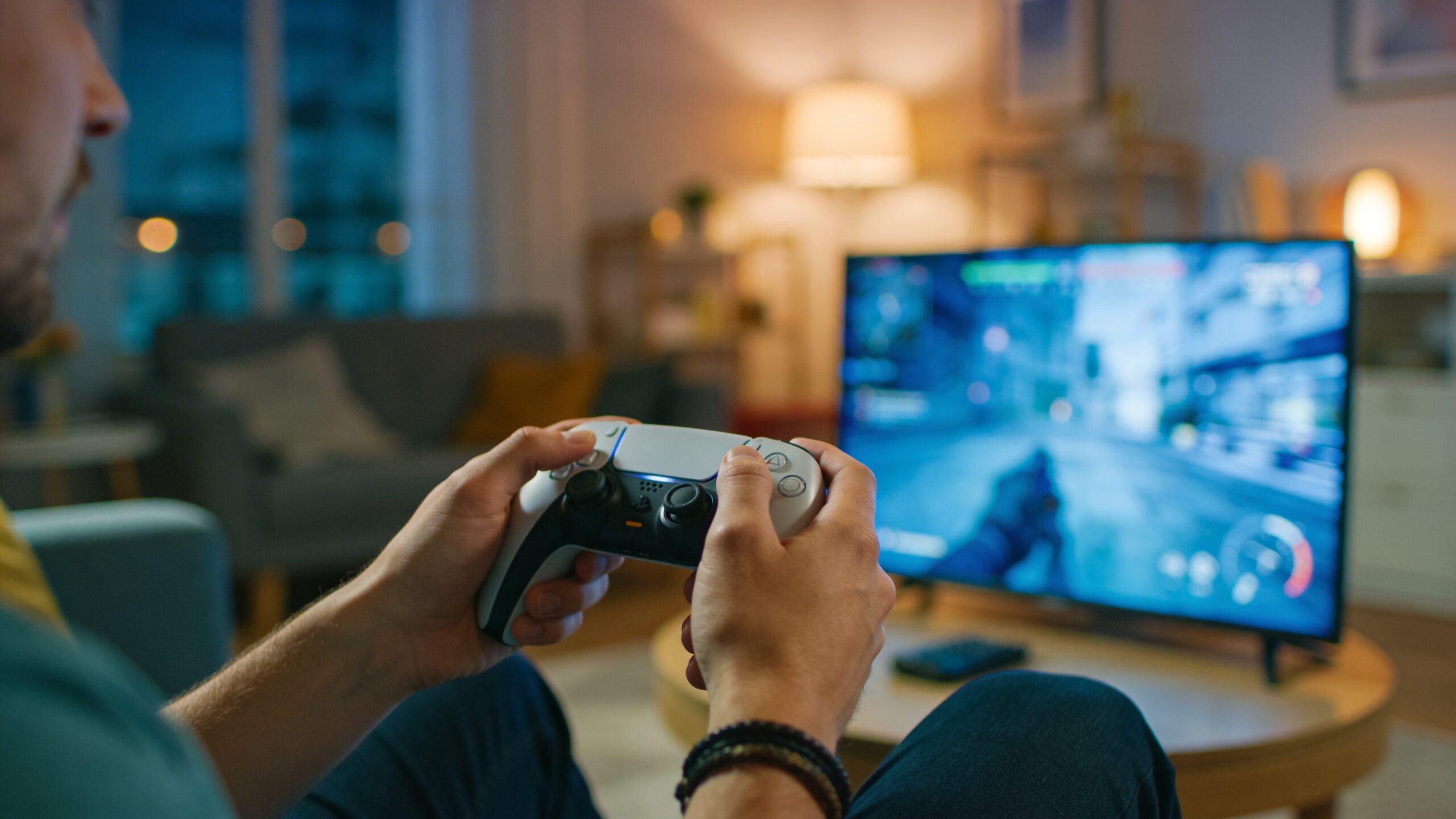
Cloud gaming once carried a stubborn reputation: impressive in concept, frustrating in practice. Players loved the promise of console-level graphics without expensive hardware, but even the smallest delay between pressing a button and seeing the result could shatter immersion. In games where milliseconds decide victory or defeat, lag was the invisible enemy. Today, that story is rapidly changing. Thanks to low-latency artificial intelligence, cloud gaming is beginning to feel immediate, responsive, and surprisingly local—almost as if the game were running right inside your own device. This shift is not the result of a single breakthrough but rather a coordinated evolution across networking, prediction algorithms, compression systems, and real-time decision engines. Low-latency AI sits at the center of this transformation, quietly anticipating player actions, optimizing data paths, and smoothing over delays before human perception ever notices them. To understand why modern cloud gaming feels so different, we need to look beneath the surface and explore how AI is reshaping the flow of information itself.
A: AI minimizes perceived lag, even if physical delay exists.
A: Stability and latency matter more than raw speed.
A: Yes, based on learned behavioral patterns.
A: Prediction and frame pacing improvements.
A: Increasingly yes, thanks to AI synchronization.
A: Low-latency displays and stable connections help.
A: Mostly anticipating.
A: Less than before, due to edge computing.
A: No, but it can feel invisible.
A: Continuously, through machine learning.
The Latency Problem That Defined Early Cloud Gaming
Latency is the round-trip delay between an input and its visible outcome. In cloud gaming, this journey is complex. A player presses a button, that input travels across the internet to a remote server, the game engine processes the action, a new frame is rendered, compressed, streamed back to the player, and finally displayed on the screen. Each step introduces delay, and when stacked together, the result can feel sluggish or disconnected.
Early cloud gaming platforms relied heavily on brute force solutions. Faster servers, better GPUs, and higher bandwidth helped, but they couldn’t fully overcome the unpredictability of networks or the physical distance between players and data centers. Human perception is unforgiving; studies show that delays above roughly 50 milliseconds can be detected in fast-paced games. Traditional systems simply reacted to inputs after they arrived, leaving no room for error or anticipation. This is where artificial intelligence changes the equation. Instead of waiting for instructions, AI-driven systems learn to expect them.
Prediction as the Core of Instant Feel
At the heart of low-latency AI is prediction. Rather than responding only after an input reaches the server, AI models continuously analyze player behavior to forecast what will happen next. These predictions are not guesses in the casual sense; they are statistically informed projections trained on millions of gameplay patterns.
When a player is sprinting forward in a shooter, the AI already expects continued movement. When a fighting game competitor begins a combo, the system anticipates the next few inputs in the sequence. By pre-rendering likely outcomes and preparing frames ahead of time, cloud servers can shave crucial milliseconds off the response loop.
If the prediction proves correct, the result feels instantaneous. If it’s slightly off, corrective frames are blended seamlessly, often faster than the brain can register the discrepancy. This predictive buffering is one of the main reasons modern cloud gaming feels dramatically more responsive than its predecessors.
AI-Driven Input Interpretation
Human input is noisy. Two players can press the same button with slightly different timing, pressure, or rhythm. Low-latency AI excels at interpreting these nuances. Instead of treating inputs as isolated commands, AI systems analyze them as part of a continuous behavioral stream.
Machine learning models recognize patterns such as hesitation before a jump, micro-adjustments in aiming, or rhythmic button presses during combat. By understanding intent rather than just action, the system can respond in a way that aligns with what the player is trying to do, not merely what was transmitted over the network.
This interpretation layer reduces perceived delay because the game responds in a way that feels natural. Even when actual network latency exists, the player experiences continuity instead of interruption.
Edge Computing and Intelligent Routing
Prediction alone is not enough. Low-latency AI also plays a critical role in deciding where computations happen. Modern cloud gaming relies heavily on edge computing, which places servers closer to players geographically. AI systems dynamically route sessions to optimal edge nodes based on real-time conditions such as congestion, packet loss, and regional demand.
Instead of using static routing rules, AI continuously evaluates network performance and reroutes streams before issues become noticeable. If a data path begins to degrade, the system can proactively shift the workload to another edge location or adjust streaming parameters on the fly.
This intelligence turns the network itself into an adaptive system. From the player’s perspective, the game simply feels stable and immediate, even as complex decisions unfold invisibly behind the scenes.
Smarter Compression Without Visible Delay
Video compression is another traditional source of latency. Compressing high-resolution, high-frame-rate video in real time is computationally expensive. Older systems had to choose between quality and responsiveness. Low-latency AI removes this tradeoff.
AI-based codecs analyze each frame and predict which visual elements matter most to the player. Fast-moving characters, aiming reticles, and interactive objects receive priority, while background elements are compressed more aggressively. The result is faster encoding and decoding without obvious loss in perceived quality.
More importantly, AI models adapt compression strategies dynamically based on gameplay context. A quiet exploration scene is handled differently from a chaotic multiplayer battle. This contextual awareness keeps frame delivery smooth, reducing both delay and visual artifacts.
Frame Pacing and Perceptual Synchronization
Even when frames arrive quickly, inconsistent pacing can ruin immersion. Sudden micro-stutters or uneven frame intervals are often more noticeable than steady, slightly higher latency. Low-latency AI focuses heavily on perceptual synchronization—aligning what the player sees with how the brain expects motion to behave.
AI systems monitor display refresh rates, input timing, and rendering pipelines simultaneously. They adjust frame delivery to maintain rhythmic consistency, smoothing out variations before they reach the screen. This makes motion feel fluid and responsive, even under fluctuating network conditions. The brain is remarkably forgiving when motion appears coherent. By optimizing for perception rather than raw technical metrics, AI creates the illusion of immediacy.
Multiplayer Responsiveness and Fairness
Latency issues become even more complex in multiplayer games, where fairness is as important as speed. Low-latency AI helps ensure that players experience consistent interactions, regardless of their physical location.
AI-based synchronization systems predict player actions across multiple clients and resolve conflicts intelligently. Instead of relying solely on server authority after the fact, AI anticipates interactions such as collisions, shots, or abilities and prepares outcomes in advance. Corrections are applied smoothly, avoiding the jarring “snapbacks” that once plagued online games. This approach not only reduces perceived lag but also enhances competitive integrity. Players feel that outcomes are fair and skill-based, not dictated by network luck.
Learning From Each Player Over Time
One of the most powerful aspects of low-latency AI is personalization. The system does not treat all players the same. Over time, it learns individual habits, reaction speeds, and preferences.
For a player who favors aggressive play, predictions skew toward forward motion and rapid input chains. For a cautious strategist, the system anticipates pauses and defensive actions. This personalization improves prediction accuracy, which directly translates to lower perceived latency.
As the AI becomes more familiar with a player, the experience feels increasingly tailored and responsive, blurring the line between local and cloud-based execution.
Hardware Acceleration and AI Co-Design
Low-latency AI is not confined to software. Modern cloud gaming infrastructure is increasingly designed with AI acceleration in mind. Specialized hardware handles neural network inference, video encoding, and input prediction with minimal overhead.
By co-designing hardware and AI models, providers reduce processing delays that once added precious milliseconds. This tight integration allows predictive systems to operate at extremely high frequencies, constantly updating their understanding of player behavior and network conditions. The result is a feedback loop that operates faster than conscious perception, making cloud gaming feel immediate rather than remote.
Overcoming Network Variability
Internet connections are inherently unstable. Bandwidth fluctuates, packets drop, and latency spikes can occur without warning. Traditional systems reacted to these changes after the fact, causing visible stutters or input delays.
Low-latency AI takes a proactive approach. By analyzing historical patterns and real-time signals, AI models forecast network instability before it becomes disruptive. Streaming quality, prediction depth, and frame buffering are adjusted preemptively, minimizing the impact on gameplay.
From the player’s perspective, the experience remains smooth even when underlying conditions are less than ideal. This resilience is a major reason cloud gaming now works well on everyday home networks rather than requiring near-perfect connections.
Why “Instant” Is About Perception, Not Physics
No system can eliminate physical distance. Signals still travel at finite speeds, and servers are still located somewhere else. The magic of low-latency AI lies in its understanding of human perception.
The brain does not measure latency directly; it interprets continuity, responsiveness, and predictability. If the game behaves the way the player expects, small delays fade into the background. AI exploits this by aligning system responses with human expectations. By predicting intent, smoothing corrections, and maintaining rhythmic consistency, low-latency AI makes cloud gaming feel instant even when it technically is not.
The Impact on Game Design
As latency concerns diminish, game designers gain new freedom. Mechanics that once required local execution are now viable in the cloud. Fast-twitch shooters, competitive fighters, and rhythm games are no longer off-limits.
Designers can also create experiences that leverage AI-driven responsiveness, such as adaptive difficulty that reacts instantly to player performance or worlds that reshape themselves in real time. Cloud gaming becomes not just a delivery method but a platform for innovation. This shift encourages experimentation and expands the types of games that can thrive without dedicated hardware.
Accessibility and Device Independence
Low-latency AI also democratizes gaming. When responsiveness is handled in the cloud, players no longer need high-end consoles or PCs to enjoy premium experiences. A modest device with a stable internet connection becomes sufficient.
AI compensates for weaker local hardware by optimizing streams and predictions accordingly. Input latency is smoothed, visuals are adapted, and performance remains consistent across devices. This opens the door to broader audiences and more inclusive gaming ecosystems.
The Road Ahead for Cloud Gaming
Low-latency AI is still evolving. Future systems will likely incorporate deeper neural models, cross-game learning, and even more advanced perception-based optimizations. As networks improve and AI becomes more efficient, the distinction between local and cloud execution may disappear entirely. We may soon reach a point where players no longer ask whether a game is running locally or in the cloud. They will simply play, confident that their actions will be reflected instantly and accurately.
Conclusion: When Technology Gets Out of the Way
The true success of low-latency AI in cloud gaming is not technical dominance but invisibility. When players stop thinking about lag, servers, or streaming and focus entirely on the game, the technology has done its job. By predicting intent, adapting to networks, personalizing responses, and optimizing perception, low-latency AI transforms cloud gaming from a compromise into a compelling alternative. What once felt distant now feels immediate. What once lagged now responds. Cloud gaming feels instant not because the laws of physics have changed, but because artificial intelligence has learned how to work with human perception instead of against it.