The Moment Gaming Stops Living Inside the Box
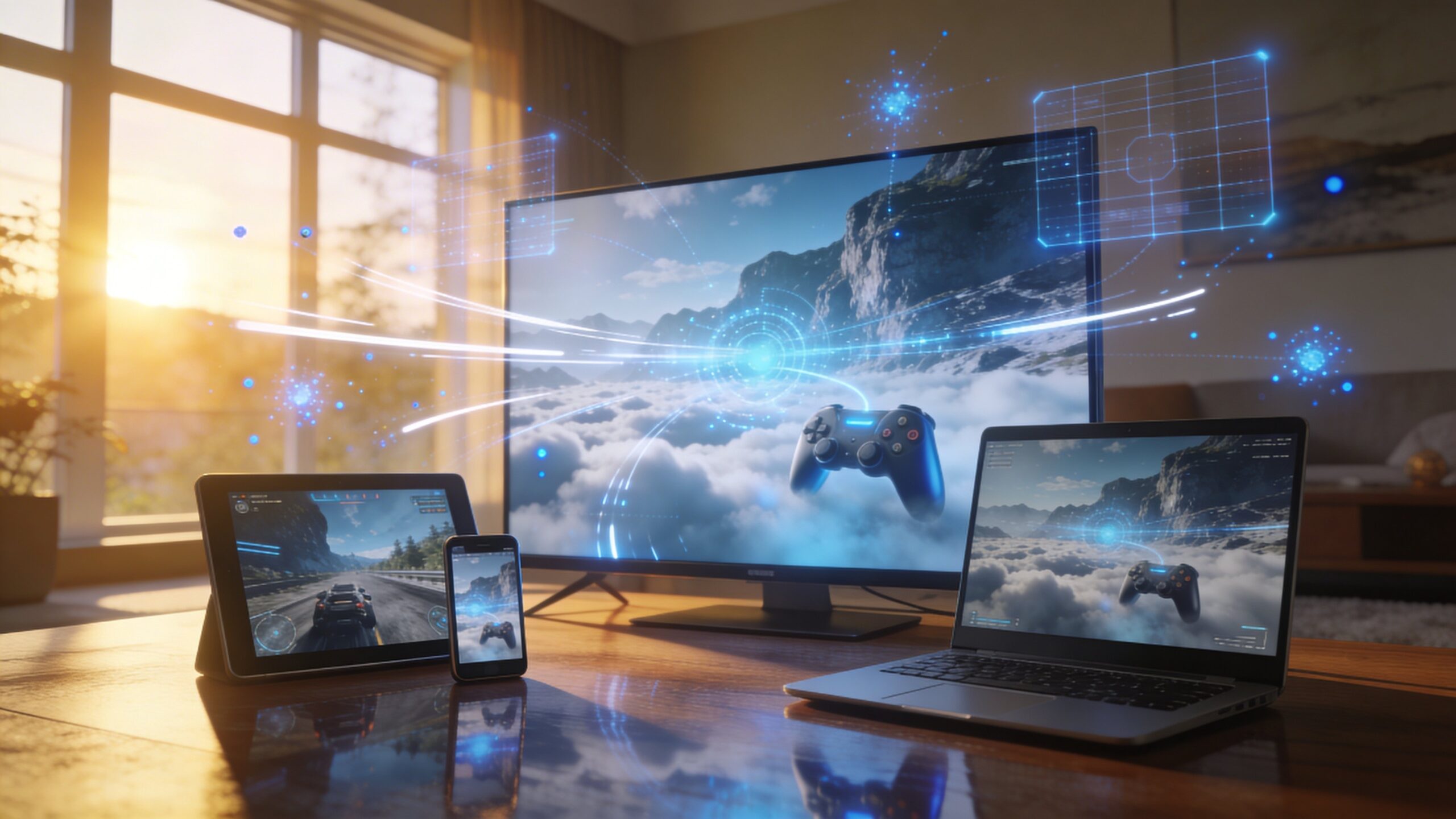
For most of gaming history, the magic happened inside a machine sitting a few feet away from the player. A console under the television, a gaming PC glowing beside a desk, or a handheld device tucked into a backpack did the heavy lifting. Graphics were rendered locally. Physics calculations happened inside dedicated chips. Save files lived on cartridges, hard drives, memory cards, or solid-state storage. The game was something you owned, installed, and ran on hardware you controlled. Cloud gaming challenges that entire model. When games run entirely in the cloud, the traditional relationship between player, machine, and software starts to change. The game no longer truly lives on your console, laptop, or phone. Instead, it runs on a powerful remote server in a data center, and what reaches you is a live, interactive video stream. Your button presses travel across the internet to that distant machine, which responds in real time, sends back updated frames, and creates the illusion that the game is happening right in front of you. In practical terms, the player’s screen becomes more like a high-speed window than the home of the game itself. That shift sounds technical, but its impact is deeply cultural, economic, and creative. If games run entirely in the cloud, the hardware race may slow down for players. The meaning of ownership may change. Developers could build bigger, more persistent worlds without worrying as much about the limitations of consumer devices. At the same time, players may become more dependent on internet quality, remote infrastructure, and subscription ecosystems. Convenience rises, but control may shrink. Accessibility improves, but permanence becomes less certain. This is why cloud gaming has become one of the most fascinating ideas in the future of interactive entertainment. It is not simply about playing a big game on a small screen. It is about rewriting the architecture of gaming itself. When the game is no longer in your living room, what changes for players, creators, publishers, and the medium as a whole?
A: Usually no; the remote server handles most of the heavy processing.
A: No; streaming plays the game remotely, while downloading installs it on your device.
A: Input delay, bandwidth issues, Wi-Fi instability, or long distance from servers can all add latency.
A: For some players yes, but others still prefer local performance, ownership, and offline access.
A: Story-driven, slower-paced, and turn-based games often adapt more comfortably than twitch-based competitive titles.
A: Usually much less than traditional installs because the game runs remotely.
A: Yes; one of cloud gaming’s biggest benefits is easier device switching across supported platforms.
A: Often you are buying access through a service, not permanent local possession.
A: Yes; Ethernet usually offers more stable performance and lower latency.
A: High-end gaming becoming more accessible without requiring expensive local hardware upgrades.
How Cloud Gaming Actually Works
At its core, cloud gaming is a bit like streaming a movie, except far more demanding. With a movie, the content is pre-recorded. Your device only has to decode a video stream and play it back smoothly. With a cloud game, the content is generated on demand based on what you do every second. Every movement, jump, shot, decision, or camera turn has to be transmitted to a server, processed almost instantly, rendered into a new frame, compressed, and sent back to you. That entire round trip must happen so quickly that the game still feels responsive. The data center becomes the true console. Powerful server hardware runs multiple game sessions, often using virtualization and optimized infrastructure to distribute resources efficiently. The player’s device becomes more of an access terminal. It still matters, of course, because it must decode the incoming video, display it clearly, and maintain a steady network connection. But it does not need the same kind of raw processing muscle as a traditional gaming machine. In theory, a modest tablet, laptop, smart television, or smartphone can access games that once demanded expensive hardware. The internet connection becomes the invisible controller cable. Latency, bandwidth, packet loss, and stability now shape the experience just as much as GPU power once did. A fast connection is helpful, but consistency is often even more important. A game that looks stunning but stutters every few moments can feel worse than a locally installed game with lower visual fidelity. This is one of the defining truths of cloud gaming: performance is no longer just about chips and specs. It is about distance, infrastructure, and timing.
A World Without Constant Hardware Upgrades
One of the most exciting promises of cloud gaming is the possibility of breaking free from the upgrade treadmill. For decades, players have been conditioned to expect a new console generation or an expensive PC refresh every few years. Graphics cards become outdated. Storage fills up. Load times become frustrating. New games arrive with higher system requirements and quietly push older hardware toward irrelevance. If games run entirely in the cloud, much of that pressure shifts away from the player. Instead of buying a stronger device, the player taps into stronger remote hardware. The server can be upgraded behind the scenes. Visual improvements, faster load times, and more advanced rendering features can appear without requiring everyone to buy a new box for their home. That is a powerful idea, especially for players who love games but cannot justify the cost of premium gaming hardware.
This could open the door to a broader gaming audience. Students, casual players, families, and budget-conscious households might gain access to high-end experiences through screens they already own. A lower hardware barrier can make gaming feel less exclusive and more universal. In the best-case scenario, cloud gaming helps turn premium games into something more approachable, less tied to luxury tech, and easier to access across different lifestyles. Still, there is a tradeoff. When local hardware matters less, cloud service providers matter more. The consumer may save money on devices, but become more dependent on subscriptions, network quality, and service availability. The cost does not disappear. It changes shape.
The End of Long Downloads and Giant Install Files
Modern gaming has become increasingly bloated. Massive installs, multi-gigabyte updates, day-one patches, shader compilation, and storage management have turned the simple act of starting a game into a small project. Players delete old favorites to make room for new releases. They wait for downloads, reorganize drives, and wrestle with compatibility issues. The excitement of a launch can get buried under setup. Cloud gaming offers a cleaner dream. Click the game, and it starts. No install. No patching on the user’s end. No storage panic. No waiting for an enormous update before a quick session. That convenience could become one of the strongest arguments in favor of cloud-based play. It reduces friction, and friction is often what keeps people from returning to games regularly.
This matters for discovery as much as convenience. When access becomes instant, players are more likely to sample new genres, try unfamiliar titles, or jump into a friend’s recommendation without hesitation. The difference between “I might play that someday” and “I’ll try it right now” can be enormous. Entire business models may evolve around that immediacy, encouraging more experimentation and lowering the commitment required to explore new games. Yet that same convenience also nudges gaming closer to an on-demand media model. Games become less like software you keep and more like experiences you temporarily access. The ease is real, but so is the shift in mindset.
What Changes for Game Design
If developers no longer have to target the exact limitations of a player’s home device, game design can begin to stretch in new directions. Cloud infrastructure could support richer simulations, larger persistent worlds, smarter AI systems, and more seamless experiences that do not rely on local storage or hardware tricks. Instead of designing around the fixed limits of a console, developers could build around server-scale flexibility. This does not mean every game suddenly becomes bigger, louder, or more complex. Sometimes the most important changes are subtle. A cloud-native game might maintain living worlds that continue evolving even when players log off. It might simulate huge ecosystems in real time. It might allow for more dynamic social spaces, faster content updates, or more complex interactions between thousands of participants. The cloud creates room for ambition beyond the constraints of a single device.
It may also influence how games are structured. Save states can become more fluid. Cross-device continuity becomes easier. A session can begin on a television, continue on a phone, and finish on a laptop without traditional syncing headaches. Games may start to feel less tied to a place and more tied to the player’s identity and network connection. At the same time, designers must account for the realities of cloud performance. Fast-paced competitive games demand extremely low latency. Certain genres may adapt better than others. Turn-based games, slower adventures, strategy titles, and narrative experiences may thrive first, while twitch-heavy genres continue to expose the limits of network response. The cloud expands design possibilities, but it also introduces a new set of creative constraints.
Ownership, Access, and the Fragile Future of Game Libraries
Perhaps the biggest philosophical question around cloud gaming is simple: if a game runs entirely in the cloud, do you really own it? Traditionally, even digital purchases often involved local installation files, downloadable assets, or at least some level of software possession. With a fully cloud-based game, access depends on remote infrastructure staying online and licensed for your use. That changes the emotional contract between player and product. A physical cartridge can be kept for decades. A downloaded game can sometimes remain playable even after storefronts change. A cloud-only title exists as long as servers, publisher agreements, and platform strategies allow it to exist. If the service ends, the game can vanish in a far more complete sense. Not just unsupported, but inaccessible. For players who care about preservation, modding, archival culture, and long-term access, this is a serious concern. Gaming history has already suffered from server shutdowns and delisted titles. A future built heavily on cloud-only access could intensify those problems. Entire experiences may disappear without a practical way to recover them. On the other hand, many consumers increasingly prioritize access over ownership in music, film, and television. Gaming may follow the same pattern. Large libraries, flexible subscriptions, and instant play are attractive. But games are not passive media. Their preservation matters differently because they are systems, spaces, and forms of interaction. When a cloud game disappears, the loss can be deeper than losing a movie from a catalog. A playable world is not easy to replace.
The Subscription Era Gets Stronger
Cloud gaming fits naturally with subscription services. The technology and the business model complement each other. If the platform is already providing remote hardware, server time, streaming infrastructure, and library access, it makes sense to bundle games into recurring memberships. This can feel generous from the consumer side at first: more content, lower upfront cost, and fewer barriers to entry. For publishers and platforms, subscriptions create a more predictable revenue stream and encourage ecosystem loyalty. The goal becomes keeping players engaged within a service rather than selling a single game once. This can influence which projects get funded, how success is measured, and how often content is updated. Retention becomes a central metric. Ongoing engagement matters more.
That shift may produce real benefits, including easier access to diverse libraries and reduced pressure to make every purchase feel risky. But it also introduces a new tension. When success is increasingly tied to service economics, game development may tilt toward retention strategies, platform exclusivity, and ecosystem lock-in. Players may gain convenience while losing some flexibility to move between services freely. Cloud gaming is not solely responsible for that trend, but it accelerates it. When the infrastructure, the storefront, the library, and the runtime environment all belong to the same platform, the ecosystem becomes extremely powerful.
The Internet Becomes Part of the Game
When gaming moves entirely to the cloud, internet quality stops being a background utility and becomes part of the core experience. A local game can survive a shaky network if it is single-player or already installed. A cloud-only game cannot. The connection is the experience. If it weakens, the game weakens with it. This reality creates a new kind of inequality. Players in cities with strong broadband or next-generation connectivity may enjoy smooth, flexible access across devices. Players in rural regions, bandwidth-capped households, or unstable network environments may face compression artifacts, lag, disconnects, or unusable performance. Cloud gaming can make high-end gaming more affordable, but it can also make good internet more essential than ever.
That means the future of cloud gaming is tied to infrastructure far beyond the games industry. Broadband expansion, Wi-Fi quality, mobile network reliability, edge computing, and regional server placement all shape how viable this model becomes. The dream of instantly playing anything on any screen sounds universal, but in practice it depends on very physical systems of cables, towers, routers, and data centers.
Why the Cloud Future Is Both Exciting and Unfinished
The idea of games running entirely in the cloud feels futuristic because it dissolves many of the old limits of gaming. It promises powerful experiences without expensive hardware, instant access without giant downloads, and flexible play across multiple screens. It invites developers to imagine new kinds of worlds and gives players more freedom to jump in quickly. In many ways, it moves gaming closer to a service that follows you wherever you are. But it also asks players to accept new dependencies. Your game may be available everywhere, but only when the network works. Your hardware costs may drop, but subscription dependence may rise. Your library may become easier to access in the short term, but harder to truly keep in the long term. Convenience expands, while ownership becomes more abstract. That is why cloud gaming remains so compelling. It is not simply a better or worse version of traditional gaming. It is a redefinition of what gaming can be when computation, access, and identity are separated from the device in your hands. Some players will love that shift. Others will resist it. Most will likely live in a mixed future, where local installs and cloud access coexist for different reasons. If games run entirely in the cloud, gaming does not disappear into thin air. It becomes something more distributed, more immediate, and more dependent on systems we rarely see. The screen stays in front of you, the controller stays in your hands, and the adventure still feels personal. But behind that familiar experience, the center of gaming moves somewhere else entirely. And once that center moves, the whole industry starts to move with it.