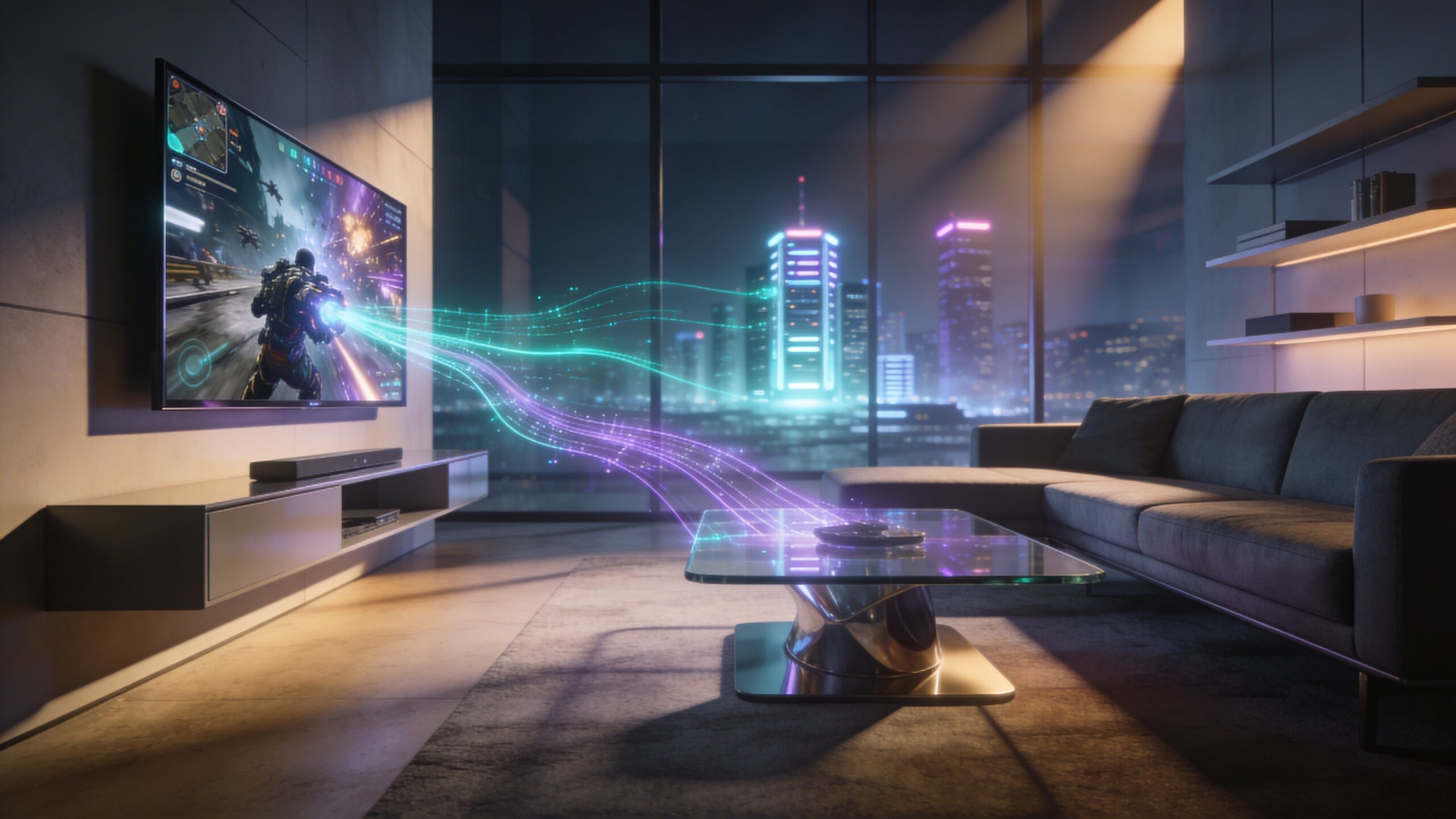
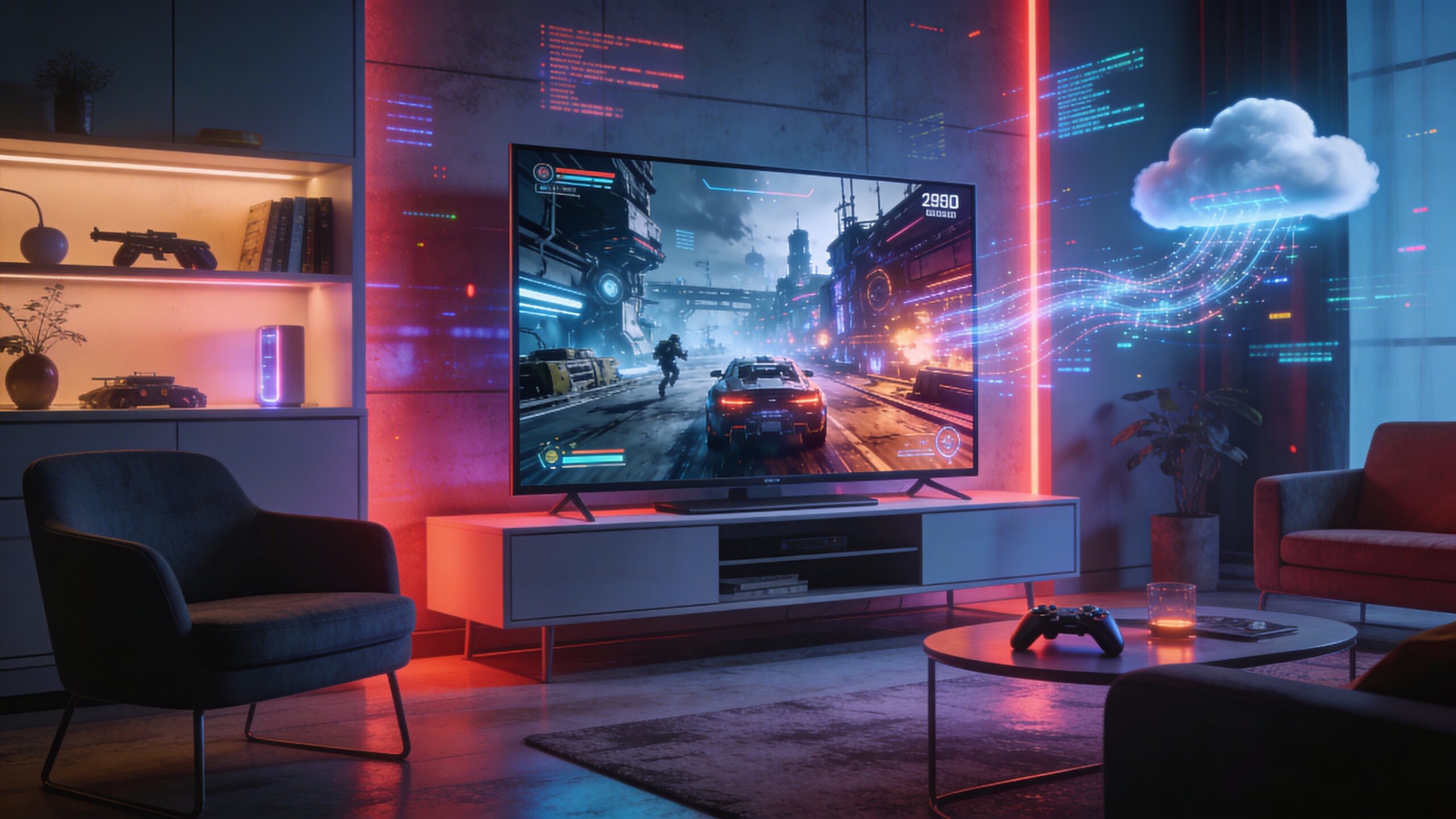
For decades, playing AAA video games meant committing to expensive hardware. Consoles arrived every generation with new specs, PCs demanded constant upgrades, and the line between “cutting-edge” and “obsolete” grew thinner each year. Today, that model is quietly unraveling. Thanks to AI-powered game streaming, players can now access blockbuster titles without owning a console or a high-end gaming PC. The future of gaming is no longer anchored to the device in your living room—it lives in the cloud. AI streaming is transforming how games are rendered, delivered, and experienced. Instead of relying on local hardware, powerful remote servers do the heavy lifting while artificial intelligence ensures that gameplay feels responsive, visually rich, and remarkably smooth. What once sounded like science fiction is now reshaping the gaming industry at every level.
A: No, games run on cloud servers instead.
A: Stable broadband is recommended for best performance.
A: Yes, most devices with screens are supported.
A: No, servers often run at ultra settings.
A: AI prediction minimizes delay for most players.
A: Some services stream owned titles, others use subscriptions.
A: Yes, sessions sync across devices.
A: All updates happen server-side.
A: Server-side processing reduces cheating and piracy.
A: Consoles may evolve, but streaming expands choice.
From Hardware Dependence to Cloud Freedom
Traditional gaming systems are limited by physical constraints. Consoles and PCs must contain processors, graphics cards, memory, and cooling systems capable of running increasingly complex games. Developers push hardware to its limits, while players face rising costs just to keep up.
AI-driven streaming platforms change this equation entirely. Games run on industrial-grade servers located in data centers optimized for performance. These machines are far more powerful than consumer hardware and are constantly upgraded behind the scenes. The player’s device—whether it’s a laptop, tablet, smart TV, or phone—becomes a window rather than the engine. This shift removes the hardware barrier. You no longer need a $500 console or a $2,000 gaming PC. If your screen can display video and your connection can handle streaming, you’re ready to play.
The Role of AI in Real-Time Game Streaming
At its core, cloud gaming involves rendering a game remotely, compressing the video output, and streaming it to the player in real time. What makes modern platforms viable is artificial intelligence. AI algorithms optimize every step of the process, from predicting player input to enhancing visual quality under imperfect network conditions.
One of the most critical challenges in streaming games is latency. Even a slight delay between pressing a button and seeing the result can ruin immersion. AI helps mitigate this by predicting player actions based on patterns and game context. By anticipating what you’re likely to do next, the system prepares frames in advance, reducing perceived lag.
AI also dynamically adjusts video encoding. If your connection fluctuates, the system reallocates resources in milliseconds, prioritizing motion clarity, input responsiveness, or resolution depending on the situation. Instead of abrupt drops in quality or freezes, players experience smooth transitions that preserve playability.
AAA Games Without Compromise
AAA games are defined by their scale, visual fidelity, and complexity. Massive open worlds, cinematic lighting, realistic physics, and advanced AI-driven NPCs demand enormous computing power. Traditionally, these experiences were exclusive to high-end consoles or PCs.
With AI streaming, these same games run on server-grade GPUs and CPUs optimized for gaming workloads. Ray tracing, ultra-high textures, and advanced physics simulations are handled remotely. Your local device simply displays the result.
This means a budget laptop can run the latest blockbuster release at settings that would overwhelm its internal hardware. The experience is no longer constrained by what you own but by the infrastructure powering the cloud.
Device-Agnostic Gaming Becomes the Norm
One of the most revolutionary aspects of AI streaming is device independence. Players can jump from a desktop computer to a tablet, then continue on a television without reinstalling software or syncing saves manually. Progress lives in the cloud alongside the game itself.
This flexibility changes gaming habits. Sessions become shorter, more spontaneous, and less tied to a single location. A few minutes on a phone during a break can transition seamlessly into a long session at home. AI-driven session management ensures consistent performance regardless of where or how you play. The idea of “platform exclusivity” begins to blur when the same game can be streamed to virtually any screen.
AI Upscaling and Visual Enhancement
Another quiet revolution happening behind the scenes is AI-powered upscaling. Rather than streaming native ultra-high-resolution video at enormous bandwidth costs, platforms often stream at lower resolutions and use AI to reconstruct missing detail on the fly.
Machine learning models trained on vast image datasets analyze textures, edges, lighting, and motion to intelligently enhance visuals. The result often looks sharper and cleaner than traditional scaling methods. This allows high-end visuals even on slower connections while reducing data usage.
AI can also stabilize frame rates, smooth motion, and reduce compression artifacts. These enhancements happen in real time, invisible to the player but crucial to maintaining immersion.
Redefining Game Ownership and Access
AI streaming is not just a technical shift; it’s a philosophical one. Instead of owning physical discs or massive local installations, players access libraries of games through subscriptions or cloud-linked purchases. Games are always updated, patched, and ready to play.
This model resembles the evolution of music and video streaming. Convenience replaces clutter, and access replaces ownership. For developers, it means fewer compatibility issues and piracy concerns. For players, it means instant access without downloads or storage management. While some players still value physical ownership, AI streaming is expanding the audience by removing friction and lowering the barrier to entry.
The Infrastructure Behind the Magic
Delivering AAA games through the cloud requires more than just fast servers. It depends on globally distributed data centers, edge computing, and AI-driven network optimization. By placing servers closer to players geographically, platforms reduce latency and improve consistency.
AI monitors network conditions in real time, rerouting data and adjusting delivery paths to avoid congestion. If a local node experiences issues, the system can seamlessly transition to another without interrupting gameplay. This invisible infrastructure is one of the reasons cloud gaming feels increasingly natural rather than experimental.
How Major Platforms Are Using AI Streaming
Several major players are already demonstrating what AI-driven streaming can achieve. NVIDIA uses advanced AI upscaling and low-latency encoding in its cloud gaming service, GeForce NOW, allowing users to stream games they already own on other platforms. The system leverages powerful GPUs and machine learning to deliver high-quality visuals with minimal lag.
Microsoft integrates AI streaming into Xbox Cloud Gaming, tying it directly to its broader gaming ecosystem. By combining cloud infrastructure with AI-assisted performance optimization, Microsoft allows players to access console-quality experiences across multiple devices.
Meanwhile, Amazon explores AI-driven cloud gaming through Luna, leveraging its vast cloud infrastructure to experiment with new distribution models and interactive features. These platforms demonstrate that AI streaming is not a niche experiment but a core strategy for the future of gaming.
Breaking Down the Cost Barrier
One of the most compelling advantages of AI streaming is affordability. Instead of a large upfront investment in hardware, players typically pay a monthly subscription or per-game access fee. This model aligns better with casual and mid-core gamers who may not want to commit to expensive upgrades.
Even for hardcore players, the cost savings over time can be significant. No GPU upgrades, no console refresh cycles, and no storage expansions are required. The cloud absorbs those costs and distributes them across millions of users. AI also helps optimize resource usage, ensuring that servers run efficiently and costs remain manageable for providers.
Accessibility and Inclusion Through Streaming
AI streaming is expanding gaming’s reach to audiences previously excluded by cost, geography, or physical limitations. Players in regions where consoles are expensive or scarce can access the same games as anyone else. Older devices gain new life as gaming portals rather than obsolete hardware.
Accessibility features powered by AI—such as adaptive controls, real-time language translation, and visual enhancements—can be implemented at the server level. This means improvements benefit everyone instantly without requiring updates or new hardware. The result is a more inclusive gaming ecosystem that welcomes a broader range of players.
Challenges Still Facing AI Game Streaming
Despite its promise, AI streaming is not without challenges. Reliable high-speed internet remains essential, and performance can vary depending on location and network quality. While AI mitigates many issues, it cannot fully overcome severe connectivity limitations.
There are also concerns around data usage, long-term ownership, and preservation. When games exist primarily in the cloud, questions arise about access if services shut down or libraries change. However, these challenges are actively being addressed through improved infrastructure, hybrid ownership models, and evolving standards.
The Developer Perspective
For developers, AI streaming offers new creative freedom. Instead of optimizing for a wide range of hardware configurations, studios can target standardized server environments. This allows more ambitious designs, larger worlds, and more complex simulations.
AI-driven analytics also provide insights into player behavior at an unprecedented scale. Developers can observe how players interact with environments, where they struggle, and how they engage with narratives, all while respecting privacy constraints. This feedback loop enables faster iteration and more responsive game design.
The Future of AAA Gaming in the Cloud
As AI models improve and global networks expand, the line between local and cloud gaming will continue to blur. Latency will shrink further, visuals will improve, and the concept of “minimum system requirements” may fade into history.
Future AI systems may dynamically generate content on the server based on player preferences, creating personalized experiences in real time. Entire game worlds could adapt to individual play styles without requiring local processing power. In this future, gaming becomes a service rather than a product, shaped continuously by data, intelligence, and creativity.
Why Consoles Are No Longer the Gatekeepers
Consoles will not disappear overnight, but their role is changing. They are becoming optional rather than essential. AI streaming shifts the focus from owning hardware to accessing experiences.
For many players, the appeal is obvious: instant play, no downloads, no upgrades, and freedom across devices. For the industry, it opens doors to new audiences, new business models, and new forms of interaction. The power once locked inside a plastic box is now distributed across the cloud, guided by artificial intelligence.
Conclusion: A New Era of Play
AI streaming has quietly redefined what it means to play AAA games. By moving computation to the cloud and using artificial intelligence to optimize every step, the industry has broken free from the limitations of hardware. Players can now experience premium games without consoles, without PCs, and without compromise. This transformation is not just about convenience or cost. It represents a fundamental shift in how games are created, delivered, and enjoyed. As AI continues to evolve, gaming will become more accessible, more flexible, and more immersive than ever before. The console was once the gateway to great games. Today, that gateway is everywhere—powered by AI, streamed from the cloud, and limited only by imagination.