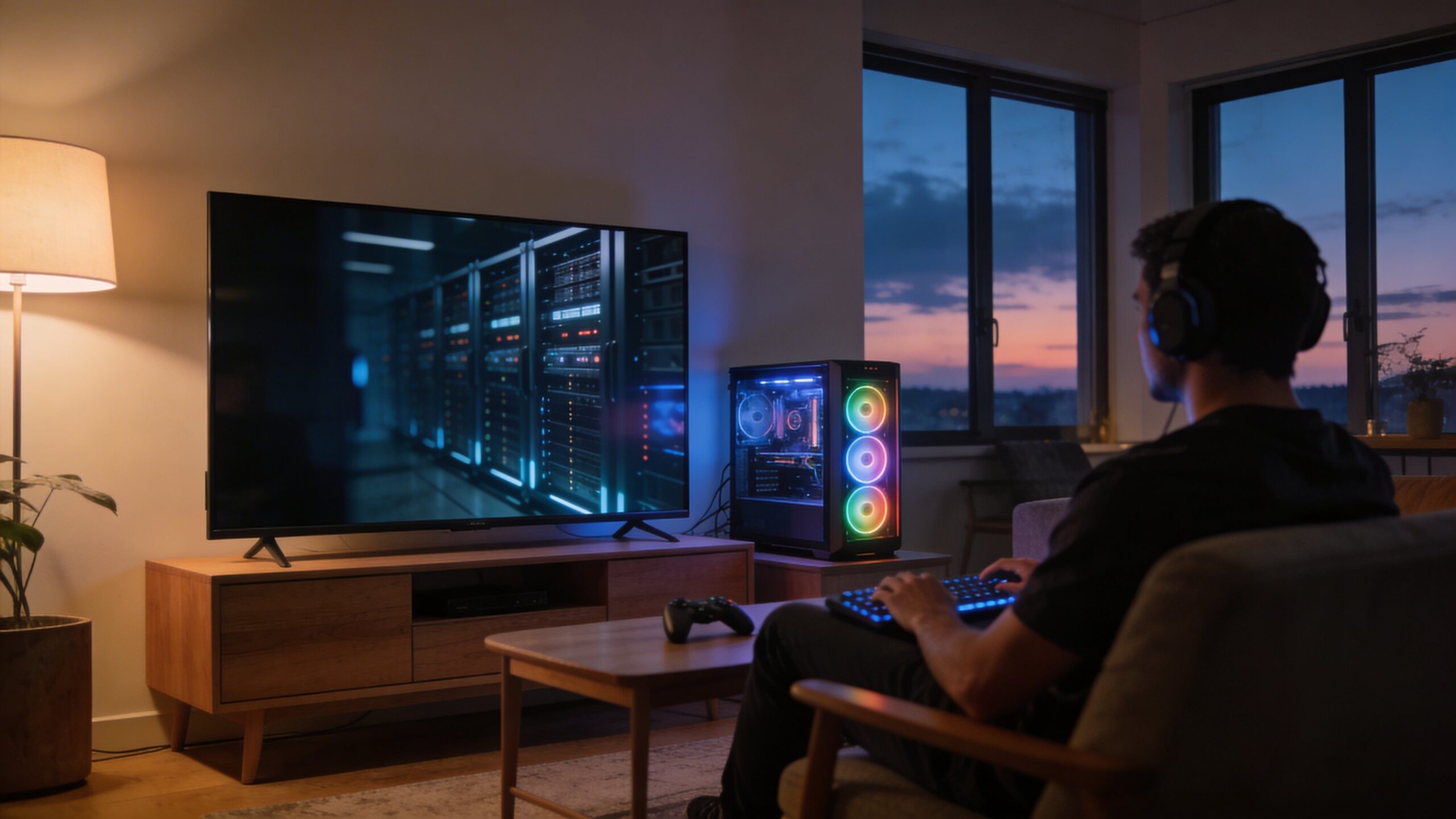
The Big Question Reshaping the Gaming Industry
For decades, gaming has revolved around physical hardware. Consoles have lived beneath televisions, gaming PCs have dominated desks, and every generation has sparked debates over power, performance, and price. But a quieter revolution is unfolding—one that challenges the very idea that powerful hardware needs to sit in your home. Cloud gaming promises instant access to high-end games streamed over the internet, raising a bold and unavoidable question: can cloud gaming truly replace consoles and gaming PCs? This question is not just about convenience. It touches performance, ownership, cost, creativity, competition, and the future shape of interactive entertainment. As cloud infrastructure improves and publishers rethink distribution, the gaming landscape is entering a transitional era where hardware dominance is no longer guaranteed.
A: Not yet; performance and ownership still favor local hardware.
A: It depends on subscription length and usage habits.
A: Yes, especially low-latency connections.
A: Casual play works better than professional competition.
A: Usually no or very limited.
A: PCs, smart TVs, tablets, and phones.
A: No, an active connection is required.
A: Casual players and hardware-free gamers.
A: Quality depends on network conditions.
A: PCs remain dominant for performance and flexibility.
Understanding What Cloud Gaming Really Is
Cloud gaming shifts the heavy lifting away from your device. Instead of rendering graphics locally, games run on powerful remote servers and stream video to your screen in real time. Your inputs—button presses, mouse movements, controller actions—are sent back to the server almost instantly, creating the illusion that the game is running locally.
Services like NVIDIA GeForce NOW, Xbox Cloud Gaming, and PlayStation Plus Premium have demonstrated that this model works, at least in principle. The idea is simple but transformative: any screen becomes a gaming machine, whether it’s a low-end laptop, a tablet, a smart TV, or even a phone.
Why Cloud Gaming Is So Appealing
The appeal of cloud gaming is immediate. There’s no upfront investment in expensive hardware. Players don’t need to worry about graphics cards, storage limits, or system requirements. Games launch instantly, updates happen behind the scenes, and switching devices is seamless.
From an accessibility standpoint, cloud gaming lowers the barrier to entry dramatically. Someone who could never afford a gaming PC can now experience visually stunning titles with little more than a controller and a stable internet connection. This democratization of gaming power is one of cloud gaming’s most disruptive strengths.
Publishers also benefit. Cloud platforms reduce piracy risks, allow easier analytics, and open new subscription-based revenue models. For developers, the ability to target standardized server hardware rather than thousands of PC configurations simplifies optimization and testing.
Performance: The Core Battleground
Despite its promise, performance remains the most contested issue. Traditional consoles and gaming PCs offer predictable, local performance. When you press a button, the response is instant because the hardware is right there. Cloud gaming introduces latency—small delays caused by data traveling to and from remote servers.
For turn-based games, strategy titles, and narrative experiences, this latency can be nearly invisible. For competitive shooters, fighting games, and fast-paced action titles, even milliseconds matter. While modern cloud services have reduced latency impressively, they still struggle to match the raw immediacy of local hardware under all conditions.
Image quality is another factor. Cloud gaming relies on video compression. Under ideal conditions, streams can look stunning, but during network congestion, visual artifacts, reduced resolution, or frame drops can occur. Consoles and PCs don’t face this problem because rendering happens locally.
Internet Infrastructure: The Hidden Gatekeeper
Cloud gaming is only as strong as the internet connection behind it. High-speed, low-latency broadband is essential. In urban areas with fiber or fast cable connections, cloud gaming can feel surprisingly close to native performance. In rural regions or countries with unstable infrastructure, the experience can degrade quickly.
Data caps also complicate adoption. Streaming high-resolution games for hours consumes massive amounts of bandwidth. For players with limited data plans, cloud gaming may be impractical or expensive compared to local gaming. Until fast, affordable, unlimited internet becomes globally accessible, cloud gaming’s reach will remain uneven.
Ownership, Control, and the Psychology of Hardware
There is also an emotional dimension to gaming hardware. Consoles and PCs represent ownership. Players buy a device, collect physical or digital libraries, and know they can play their games regardless of corporate shifts.
Cloud gaming challenges that sense of permanence. Games can be removed from services. Publishers can change licensing terms. If a service shuts down, access disappears. This lack of long-term ownership makes some players uneasy, especially those who have invested decades into building collections.
Gaming PCs also offer freedom. Modding, community patches, custom settings, and experimental tools thrive in local environments. Cloud gaming platforms are more controlled, limiting customization and mod support in many cases.
Cost Comparison: Subscription vs Investment
From a cost perspective, cloud gaming looks attractive at first glance. Monthly subscriptions are often cheaper than buying a console or upgrading a PC. There’s no need for replacement parts or mid-generation upgrades.
Over time, however, the equation becomes more complex. Long-term subscribers may end up paying amounts comparable to hardware ownership without ever truly owning anything. For hardcore gamers who play for years, a console or PC can still be a better value, especially when resale, offline play, and longevity are considered.
Cloud gaming’s cost advantage is strongest for casual players, families, and those who dip in and out of gaming rather than playing daily.
Competitive and Professional Gaming Challenges
Esports and competitive gaming highlight cloud gaming’s limitations. Professional players demand absolute precision, consistency, and reliability. Any latency fluctuation or stream artifact can influence outcomes at the highest level.
While cloud gaming may support competitive play casually, replacing local setups in tournaments and professional training environments remains unlikely in the near future. Dedicated hardware provides control and consistency that cloud platforms still struggle to guarantee universally.
Creative Freedom and Development Impacts
Cloud gaming could radically change how games are designed. Developers are no longer constrained by consumer hardware limitations. Massive simulations, persistent worlds, and advanced AI systems become more feasible when computation happens server-side.
This opens doors to experiences that consoles and PCs might never handle efficiently. Entire cities simulated in real time, thousands of concurrent players interacting in shared spaces, and complex physics-driven environments could become standard. However, this future depends on widespread adoption. Developers are unlikely to abandon traditional platforms until cloud gaming reaches critical mass.
Environmental and Sustainability Considerations
An often-overlooked angle is environmental impact. Fewer consoles and PCs could mean less electronic waste. On the other hand, massive data centers consume enormous energy, raising concerns about sustainability.
Whether cloud gaming ultimately reduces or increases environmental impact depends on energy efficiency, renewable power adoption, and infrastructure optimization. It’s not a clear win or loss, but it’s a factor that will shape long-term strategy.
Hybrid Models: The Most Likely Outcome
Rather than full replacement, the future points toward coexistence. Cloud gaming is becoming a powerful supplement to traditional hardware, not an outright substitute. Consoles and PCs are increasingly integrating cloud features, allowing players to stream games when hardware isn’t available and play locally when performance matters most.
This hybrid approach gives players flexibility. Start a game on a TV, continue on a phone, finish on a PC. Hardware becomes optional rather than mandatory, but still valuable.
The Role of Consoles in a Cloud-First World
Consoles are evolving rather than disappearing. They serve as optimized gateways—offering consistent performance, offline play, and simplified user experiences while still leveraging cloud services for streaming, downloads, and cross-device access.
Future consoles may be less about raw power and more about seamless integration with cloud ecosystems. They become anchors rather than exclusive platforms.
Gaming PCs: The Last Stronghold?
Gaming PCs are the least threatened in the short term. Their flexibility, performance ceiling, and creative freedom remain unmatched. Streamers, modders, developers, and competitive players continue to rely on PCs as the ultimate platform.
However, even PCs are adapting. Cloud services are becoming tools rather than replacements, allowing gamers to play demanding titles on weaker machines or while traveling.
Will Cloud Gaming Ever Fully Replace Hardware?
Complete replacement is unlikely in the foreseeable future. Too many variables—network reliability, latency sensitivity, ownership concerns, and creative freedom—favor a mixed ecosystem.
What cloud gaming will replace is the assumption that powerful hardware is the only way to play premium games. That mental shift alone is transformative. Gaming is becoming a service, not just a product.
The Real Transformation: Choice and Flexibility
The most profound impact of cloud gaming isn’t replacement—it’s expansion. It brings new players into the gaming world, reshapes how games are distributed, and forces hardware manufacturers to innovate beyond brute force upgrades.
Players now have more choice than ever. Console purists, PC enthusiasts, and cloud-first gamers can all coexist within a single ecosystem. The boundaries between platforms are blurring, and that convergence is redefining what it means to be a gamer.
Final Thoughts: Evolution, Not Extinction
Cloud gaming is not the end of consoles or gaming PCs. It is the next evolutionary layer in a medium that has always thrived on technological change. Just as physical media gave way to digital downloads, hardware-centric gaming is giving way to service-driven flexibility. The future of gaming will not belong to one model alone. It will belong to players who can choose how, where, and when they play—whether that’s on a cutting-edge PC, a familiar console, or a cloud-powered screen that fits in their pocket.