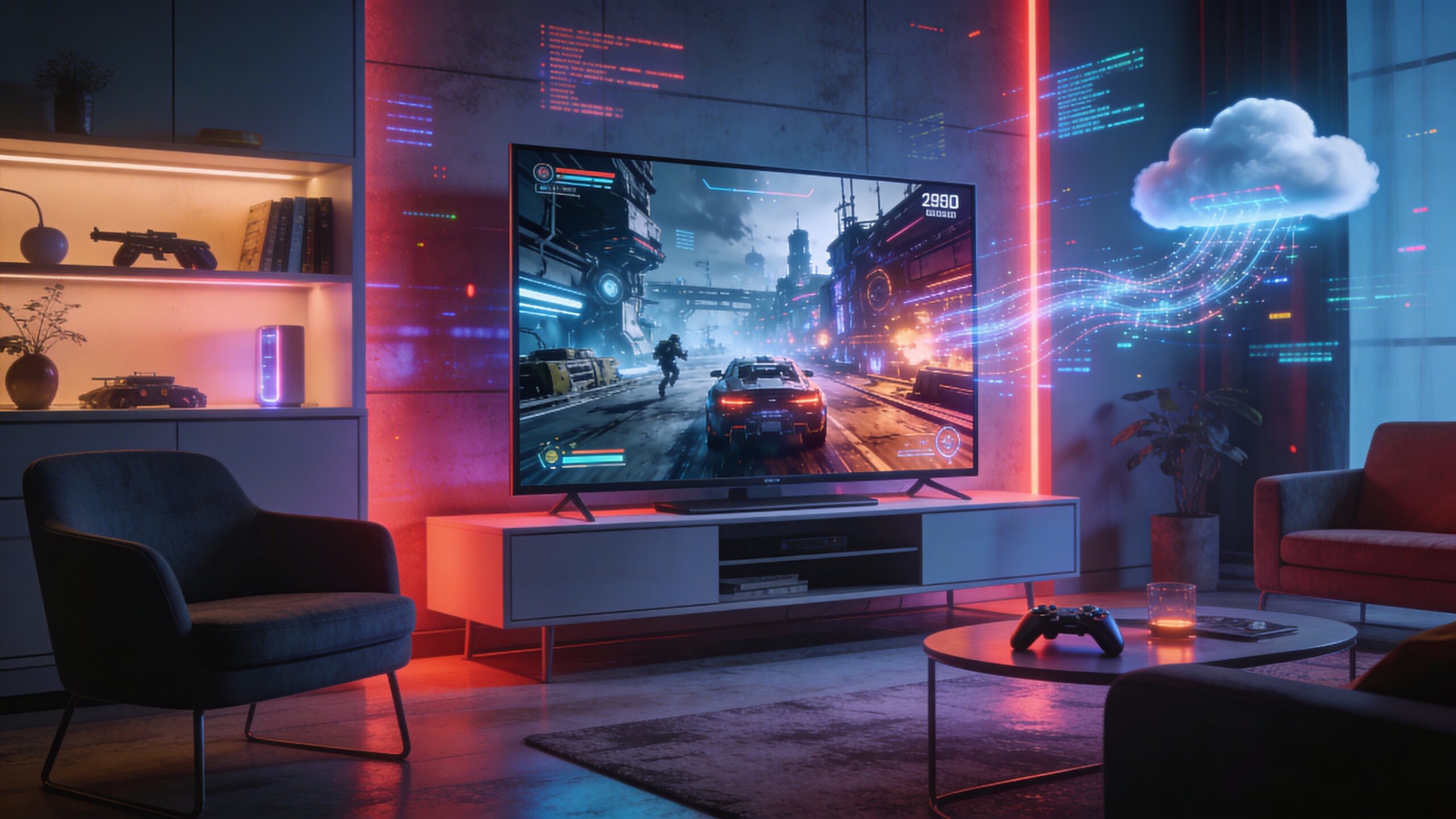
In modern gaming, milliseconds matter. A perfectly timed dodge, a rapid counterattack, or a precise aim correction can be the difference between winning and losing. As games have increasingly moved from local consoles and PCs to cloud-based streaming platforms, one persistent challenge has followed them: lag. When a game runs on a remote server instead of a device in your home, every player input must travel across the internet, be processed elsewhere, and return as a visual update on your screen. Even on fast connections, this delay can feel noticeable. To overcome this problem, streaming platforms have embraced an unexpected solution. Instead of waiting for your input to arrive before responding, they use artificial intelligence to predict what you are likely to do next. By preparing responses in advance, these systems can reduce the feeling of lag and make cloud gaming feel far more responsive than physics alone should allow. This article explores how streaming AI predicts player input, why it works, and what it means for the future of interactive entertainment, all explained in clear, non-technical language.
A: No, it predicts patterns based on probability.
A: No, but errors are quickly corrected.
A: No, actual inputs always override predictions.
A: Systems rely mostly on aggregated behavior.
A: Fast, continuous-action games.
A: Severe instability lowers effectiveness.
A: No, it only anticipates your own input.
A: Yes, but efficiency improves every year.
A: It narrows the gap, not replaces it.
A: Yes, rapidly.
Understanding Lag in Cloud Gaming
Lag in cloud gaming comes from distance and processing time. When you press a button, that signal must travel from your controller to a data center that could be hundreds or thousands of miles away. The server then updates the game state, renders a new frame, compresses it into video, and sends it back to your display. This round trip can take anywhere from tens to hundreds of milliseconds.
Even small delays are noticeable to human perception, especially in fast-paced games. Competitive players are particularly sensitive to lag because it disrupts muscle memory and timing. While faster internet connections and closer servers help, they cannot eliminate the fundamental reality that data takes time to travel. This is where predictive AI enters the picture. Instead of reacting after the fact, streaming systems try to anticipate the future.
The Idea Behind Input Prediction
Input prediction is based on a simple observation: players are not random. Human behavior in games follows patterns. When a player is running forward, they are more likely to keep running forward than to suddenly stop and spin around. When a player is aiming at a target, small adjustments are more likely than abrupt changes in direction.
Streaming AI analyzes these patterns and makes educated guesses about what a player will do next. If the system predicts correctly, it can begin rendering the next frame before the actual input arrives. When the real input does show up, the predicted result is already prepared, reducing or even eliminating perceived lag.
This does not mean the AI permanently commits to a guess. Predictions are provisional. If the player does something unexpected, the system can quickly correct course and update the stream.
Learning From Player Behavior
At the heart of predictive streaming AI is machine learning. These systems are trained on massive amounts of gameplay data collected from thousands or millions of players. The AI learns common movement patterns, aiming behaviors, and reaction sequences across different genres.
For example, in a racing game, the AI may learn that players usually continue steering smoothly through curves rather than making sharp corrections every frame. In a first-person shooter, it may learn how players track moving targets or strafe while firing. In strategy games, it may learn common sequences of camera movement and unit selection. Over time, the system builds statistical models that describe how players typically behave in specific contexts. These models allow the AI to predict not just what button might be pressed next, but how likely each possible action is.
Context Matters More Than Guessing
One of the most important aspects of input prediction is context. The AI does not guess blindly. It considers what is happening on screen, what the player has been doing recently, and what options are realistically available.
If a player character is standing still with a menu open, the likely inputs are very different from those during a frantic combat sequence. If the character is mid-jump, certain actions may not even be possible until they land. By narrowing down the range of plausible inputs, the AI can make much more accurate predictions. Contextual awareness dramatically improves prediction quality and reduces the chances of noticeable errors.
Preparing Multiple Futures at Once
In many systems, the AI does not commit to a single predicted input. Instead, it prepares several likely futures simultaneously. The server might render multiple possible next frames based on different predicted inputs, such as moving forward, turning slightly left, or turning slightly right.
When the actual input arrives, the system simply selects the already-rendered frame that matches reality. This approach is computationally expensive, but it is highly effective at reducing perceived lag. From the player’s perspective, the game responds instantly because the correct outcome was already waiting. This technique works especially well in situations where the number of reasonable inputs is small, such as steady movement or camera adjustments.
Correcting Mistakes Without Breaking Immersion
No prediction system is perfect. Sometimes the AI guesses wrong. The key to success is how the system handles these mistakes.
When an incorrect prediction occurs, the system quickly switches to the correct game state and smooths the visual transition. Instead of abruptly snapping to a new position, it may blend frames or subtly adjust motion over a few milliseconds. Most players never consciously notice these corrections, especially if they are small.
The human brain is remarkably forgiving when changes happen smoothly. Streaming AI takes advantage of this by prioritizing visual continuity over absolute precision in every frame.
Why Humans Are Predictable in Games
It may feel strange to hear that your inputs are predictable, but this is not an insult. Human nervous systems have limits. Reaction times, muscle memory, and decision-making processes introduce consistency into our actions.
Players also follow goals. If you are chasing an enemy, capturing an objective, or navigating a level, your actions are guided by that goal. Streaming AI leverages these tendencies, using probability rather than certainty to stay one step ahead.
This predictability is strongest during continuous actions like movement, aiming, and camera control, which happen many times per second and follow smooth trajectories.
Genres That Benefit Most From Prediction
Not all games benefit equally from predictive streaming. Fast-paced genres with continuous input, such as shooters, racing games, and action-adventure titles, gain the most. These games involve constant movement and camera adjustments, which are ideal for prediction.
Turn-based games, menu-heavy experiences, and slower-paced strategy titles already tolerate higher latency and gain less from predictive techniques. However, even these games can benefit in subtle ways, such as smoother camera motion or faster menu responsiveness. The more fluid and continuous the gameplay, the more opportunities AI has to reduce lag.
AI Versus Traditional Lag Compensation
Before AI-driven prediction, developers relied on techniques like buffering, interpolation, and client-side prediction. These methods helped but had limits. Buffering adds delay to ensure smooth playback, while interpolation smooths motion between known states rather than predicting new ones.
Streaming AI goes further by actively forecasting future states. Instead of merely smoothing what has already happened, it attempts to render what will happen next. This proactive approach is what makes modern cloud gaming viable for genres once thought impossible to stream.
The Role of Edge Computing
Prediction alone is not enough. It works best when combined with edge computing, where servers are placed closer to players geographically. Shorter distances mean predictions need to extend only a few milliseconds into the future rather than dozens. When AI prediction and edge computing work together, the experience can approach the responsiveness of local gaming. The AI fills in the remaining gaps that physics cannot eliminate.
Ethical and Privacy Considerations
Any system that analyzes player behavior raises questions about data use. Streaming platforms must ensure that input data is handled responsibly and anonymized appropriately. The goal is not to profile individuals but to understand general patterns.
Most predictive systems focus on aggregate behavior rather than personal identity. The AI cares about how players behave in certain situations, not who the player is. Transparency and strong privacy safeguards are essential to maintaining trust.
Limitations and Trade-Offs
Predictive streaming is powerful, but it is not magic. Complex or highly unpredictable actions are harder to forecast. Sudden changes in strategy, unusual play styles, or chaotic multiplayer interactions can reduce prediction accuracy.
There is also a computational cost. Rendering multiple possible futures requires more server resources, which can increase operational expenses. Platforms must balance responsiveness with scalability. Despite these challenges, the benefits often outweigh the costs, especially as hardware and AI models continue to improve.
How This Changes Game Design
As predictive streaming becomes more common, it may influence how games are designed. Developers might create mechanics that favor continuous motion and smoother transitions, which are easier to predict.
User interfaces may become more responsive and fluid, reducing reliance on precise frame timing. Over time, game design and streaming technology may co-evolve, each shaping the other.
The Player Experience Today
Many players already benefit from predictive streaming without realizing it. When cloud gaming feels surprisingly responsive, AI prediction is often part of the reason. The experience may not always match a high-end local PC, but the gap is closing rapidly. For casual players, the difference may be almost imperceptible. For competitive players, improvements in prediction and correction can make cloud gaming viable in situations where it once felt unusable.
Looking Toward the Future
As AI models grow more sophisticated, prediction accuracy will continue to improve. Future systems may adapt to individual play styles in real time, learning how you personally move, aim, and react.
Advances in networking, compression, and hardware acceleration will further reduce the burden on prediction systems. Eventually, the distinction between local and cloud gaming may fade entirely.
Streaming AI does not eliminate lag by breaking the laws of physics. Instead, it works around them by understanding human behavior and preparing for what comes next.
Conclusion
Streaming AI reduces lag not by speeding up the internet, but by thinking ahead. By analyzing patterns in player behavior, understanding context, and preparing multiple possible futures, these systems make cloud gaming feel responsive and natural. What once seemed like science fiction is now a practical solution to one of gaming’s biggest challenges. As technology advances, predictive AI will play an increasingly central role in how games are delivered and experienced. In the end, the goal is simple: when you press a button, the game should respond as if it were right there with you. Streaming AI brings us closer to that goal, one predicted input at a time.