
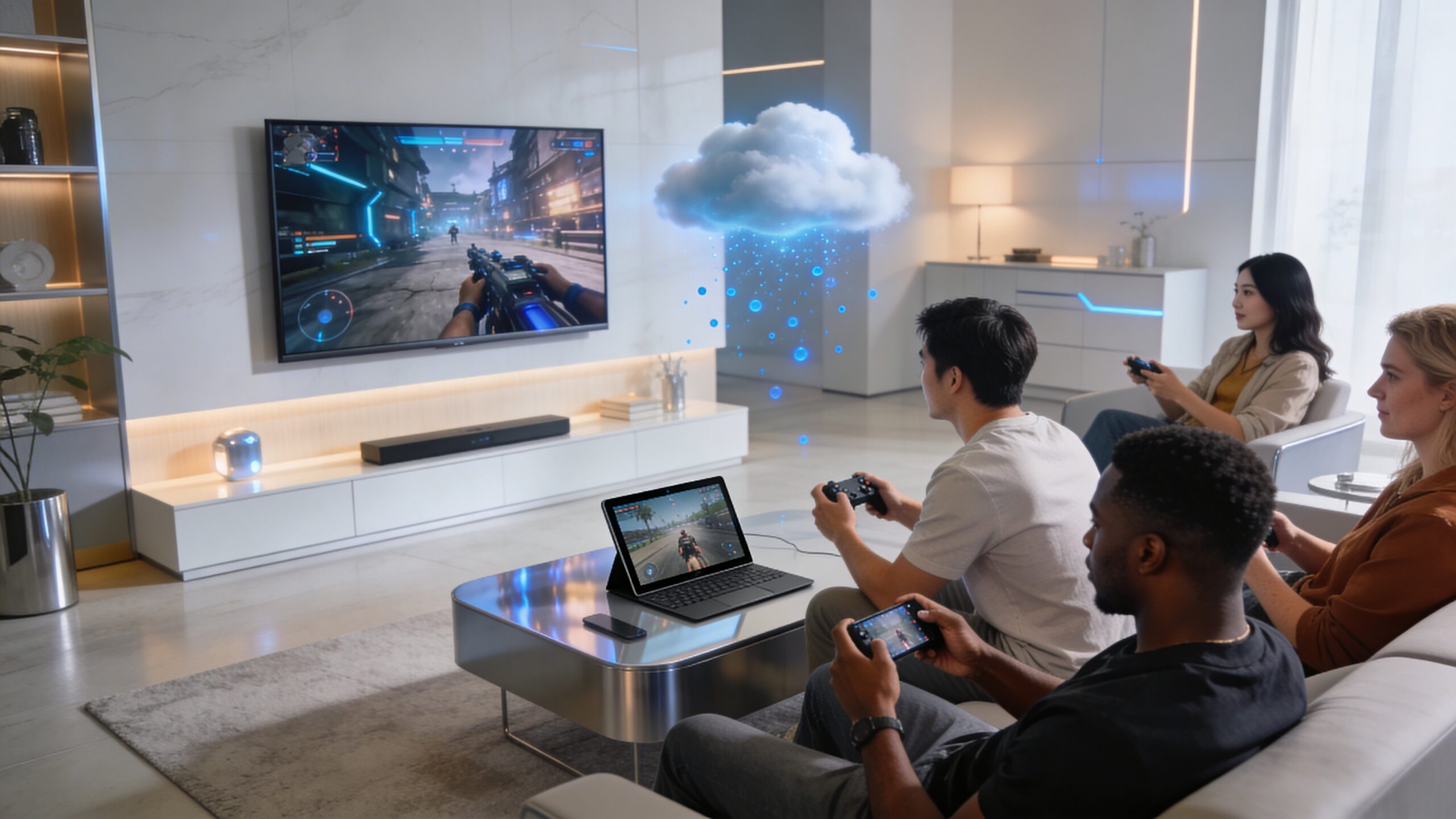
The New Scale of Play
Cloud gaming has transformed the idea of what a game platform can be. Instead of relying on a local console or gaming PC to do all the heavy lifting, cloud gaming shifts much of the workload to powerful remote servers. That change sounds simple on the surface, but it creates a massive technical challenge behind the scenes. When millions of players log in across different devices, different regions, and different network conditions, the system has to respond instantly, adapt continuously, and keep gameplay feeling smooth and fair. Artificial intelligence has become one of the most important tools in making that possible.
A: It helps predict demand, manage servers, optimize streaming, and keep gameplay smooth at scale.
A: Keeping latency low while balancing compute, bandwidth, and regional traffic in real time.
A: No, but it can reduce its impact through smarter routing, prediction, and adaptive streaming.
A: They move game processing closer to the player, which can improve responsiveness.
A: It forecasts spikes, adds capacity, and redistributes workloads before systems get overwhelmed.
A: Yes, especially through intelligent compression and stream optimization.
A: No, AI often adapts settings based on screen size, controls, and connection conditions.
A: Yes, it can detect suspicious patterns across gameplay, accounts, and server activity.
A: Because connection quality and server placement affect how fair and responsive a match feels.
A: A combination of distributed infrastructure, automation, and AI-driven orchestration.
Why Millions of Players Create a Unique Problem
A traditional game can be demanding, but cloud gaming at global scale introduces an entirely different level of complexity. Every player generates input commands, video streams, matchmaking requests, account activity, voice data, progression updates, and countless other signals. All of this must be processed in real time while preserving low latency, high image quality, and stable server performance. The more players join, the more pressure builds on networks, compute resources, and storage systems. AI helps operators make fast decisions that would be impossible to manage manually at this scale.
AI as the Invisible Game Operations Brain
In cloud gaming systems, AI often works like an invisible operations brain. It watches patterns across the entire platform and reacts before small problems turn into major disruptions. Instead of waiting for servers to overload or for network congestion to ruin a match, AI models can forecast what is likely to happen next. They identify spikes in demand, recognize unusual behavior, allocate resources, and help route players to the best available infrastructure. That means AI is not just a gameplay tool. It is also an essential coordination system for the entire cloud gaming ecosystem.
Predicting Player Traffic Before It Happens
One of the biggest advantages of AI in cloud gaming is prediction. Millions of players do not arrive randomly. They tend to log in after work, during weekends, after major updates, or when live events and influencer streams create sudden interest. AI systems analyze these behavior patterns across regions and time zones to estimate demand before it happens. If a major title is expected to see a surge in players at 7 p.m. in North America and another wave later in Europe, the platform can prepare capacity in advance. That reduces slowdowns, minimizes wait times, and improves the overall experience before players even notice anything happening.
Smart Resource Allocation Across Data Centers
Cloud gaming depends on expensive, high-performance infrastructure. Graphics processors, CPUs, memory pools, and streaming encoders all have to be used efficiently. If too many resources sit idle, the system becomes wasteful. If too few are available, players face lag, queues, or dropped sessions. AI helps strike the right balance. It learns how different games consume resources, how long sessions usually last, and what kinds of devices players are using. Based on that information, it can assign computing power where it is most needed and shift workloads between data centers to keep the service stable.
Matching Players to the Best Server in Real Time
Not every player should connect to the same server, even if they are playing the same game. Distance, local internet conditions, congestion, device type, and platform load all affect performance. AI-powered routing systems analyze these factors in real time and determine which server or edge node is most likely to deliver the lowest latency and best visual quality. This is especially important in cloud gaming because the system is not only sending game data. It is also streaming video frames back to the player with minimal delay. Even small improvements in routing can make controls feel more responsive and gameplay more natural.
Reducing Latency Through Intelligent Prediction
Latency is one of the biggest obstacles in cloud gaming. When a player presses a button, that command travels to a remote server, gets processed, and then returns as a video frame. AI helps reduce the visible impact of this delay in several ways. Some systems predict short-term player inputs based on recent actions, especially in highly repetitive or directional movement. Others optimize frame generation and video encoding so the most important visual data is prioritized first. The goal is not to guess the game for the player, but to smooth out the experience enough that it still feels immediate and controlled.
AI-Driven Video Compression for Massive Streaming Demand
A cloud gaming platform serving millions of players is also operating one of the most demanding video delivery systems in the world. Every gameplay session becomes a live interactive video stream. Sending all of that visual information at high quality would overwhelm even advanced networks if done inefficiently. AI-driven video compression helps solve this. Machine learning models can determine which parts of a frame matter most to visual clarity and which can be compressed more aggressively without the player noticing. That allows platforms to preserve image quality while reducing bandwidth use, making cloud gaming more scalable and more accessible on a wider range of connections.
Stabilizing Performance During Sudden Surges
Large multiplayer launches, seasonal events, surprise updates, and major esports broadcasts can create sudden waves of demand. These spikes are dangerous because they can cascade across the system. One overloaded region can push players into another. One unstable game instance can affect stream quality across many sessions. AI helps detect these surges early and react dynamically. It can spin up extra instances, rebalance traffic, lower nonessential workloads, and protect core gameplay services. Instead of treating scale as a fixed ceiling, AI allows cloud systems to behave more like living networks that can stretch and adapt under pressure.
Smarter Matchmaking at Enormous Scale
When millions of players are online, matchmaking becomes far more complex than simply pairing people by skill. A good match also depends on location, connection quality, wait time, player behavior, preferred game mode, and even device performance. AI improves matchmaking by weighing these variables together rather than relying on a rigid set of rules. This leads to faster, fairer, and more stable sessions. In cloud gaming, that matters even more because poor matchmaking can create technical problems as well as gameplay frustration. A fair match with low-latency connectivity often creates a better overall experience than a purely skill-based match with poor network conditions.
Detecting Cheating and Abuse Across Huge Populations
The larger the player base, the harder it becomes to identify cheating, exploitation, harassment, account fraud, and other harmful behavior. Manual moderation cannot keep pace with millions of concurrent players. AI systems help by scanning patterns that suggest automation, unusual account behavior, impossible in-game actions, suspicious purchases, or coordinated abuse. In cloud gaming, server-side control can already reduce some forms of cheating because the game logic often stays in the cloud rather than on the player’s device. AI strengthens that advantage by continuously learning from new behavior patterns and helping security teams respond faster.
Personalizing the Experience for Every Player
Cloud gaming at scale is not just about keeping servers online. It is also about making the experience feel tailored and engaging for each player. AI helps personalize everything from stream quality settings to game recommendations to onboarding flows. If the system detects that a player is on a less stable connection, it may prioritize smoother playback over visual sharpness. If it sees that a user prefers certain genres or session lengths, it can surface better suggestions. This personalization improves satisfaction while also helping the platform use its resources more intelligently.
Supporting Cross-Device Gaming Without Friction
One of the biggest promises of cloud gaming is that players can move from a phone to a tablet to a TV to a laptop without losing progress or performance. That flexibility creates another layer of complexity because every device has different display sizes, controls, network behavior, and performance expectations. AI helps optimize stream delivery and interface adaptation for each context. It can adjust resolution, bitrate, controller mapping assumptions, and even session continuity strategies. This allows a platform to support a vast variety of hardware while still keeping the experience consistent enough to feel like a single unified gaming world.
Using Edge Computing More Effectively
To serve millions of players well, cloud gaming platforms often move parts of their infrastructure closer to users through edge computing. AI helps decide what should happen at the edge and what should remain centralized. Some tasks benefit from being handled near the player, such as low-latency session routing or regional caching. Other tasks, such as deep analytics or global forecasting, may work better in larger core data centers. AI coordinates these layers so the platform can reduce delay where it matters most without creating unnecessary complexity or waste.
Learning From Live Gameplay Data
Every gaming session produces valuable information. AI can analyze live data from millions of sessions to learn which servers perform best, where bottlenecks emerge, how player behavior shifts during updates, and which settings produce the best balance of quality and responsiveness. This learning process allows the system to improve over time. A mature cloud gaming platform does not stay static. It becomes better at prediction, allocation, moderation, and streaming as more data flows through it. In that sense, scale is not only a challenge. It is also a source of intelligence when used correctly.
Keeping Costs Under Control While Growing
Cloud gaming is resource-intensive, and every minute of active play costs money in compute, bandwidth, and infrastructure operations. If a platform cannot control these costs, scaling to millions of players becomes difficult to sustain. AI helps by improving efficiency across the stack. It can reduce wasteful overprovisioning, improve video compression, automate maintenance decisions, and identify low-value workloads that can be delayed or reduced. This matters because the future of cloud gaming will depend not only on technical success, but also on whether large-scale service models can remain economically viable over time.
Why Reliability Matters as Much as Speed
Players rarely think about infrastructure unless something goes wrong. A momentary freeze, a queue at launch, or a sudden disconnect can damage trust quickly. AI helps improve reliability by watching for anomalies that human operators might miss. It can detect unusual packet loss, hardware stress, abnormal login behavior, or early warning signs of regional instability. Because it acts continuously, it gives cloud gaming operators a better chance to intervene before players are affected. In systems handling millions of users, reliability is not a bonus feature. It is a core part of the product.
The Future of Massive Cloud Gaming Systems
As cloud gaming grows, AI will likely take on even more responsibility. Future systems may predict entire waves of player demand days in advance, generate ultra-efficient stream formats on the fly, adapt game simulations to changing network conditions, and manage hybrid infrastructures spread across regions and edge nodes. AI may also play a stronger role in accessibility, helping personalize controls, visual settings, and assistance features for different users automatically. The result will be cloud gaming platforms that feel less like static services and more like intelligent, self-adjusting entertainment networks.
A New Kind of Interactive Infrastructure
The most exciting part of this evolution is that it changes how we think about gaming infrastructure itself. Instead of seeing servers, networks, and streaming pipelines as fixed systems, AI turns them into responsive environments that learn from players and adapt around them. That makes it possible to support huge global audiences without every player feeling like just another number in the queue. When cloud gaming works well, the complexity disappears. The session launches fast, the controls feel sharp, the visuals stay stable, and the player remains immersed. Behind that smooth experience is an enormous amount of intelligent coordination.
Conclusion
How AI handles millions of players in cloud gaming systems comes down to one central idea: orchestration at extreme scale. AI predicts demand, allocates compute power, optimizes streaming, improves matchmaking, detects abuse, and helps keep performance smooth across devices and regions. Without that intelligence layer, cloud gaming would struggle to deliver the responsiveness and reliability players expect. With it, platforms can do far more than simply host games remotely. They can create adaptive, scalable worlds that remain playable even as audiences grow into the millions. That is what makes AI such a powerful force in the future of cloud gaming.


