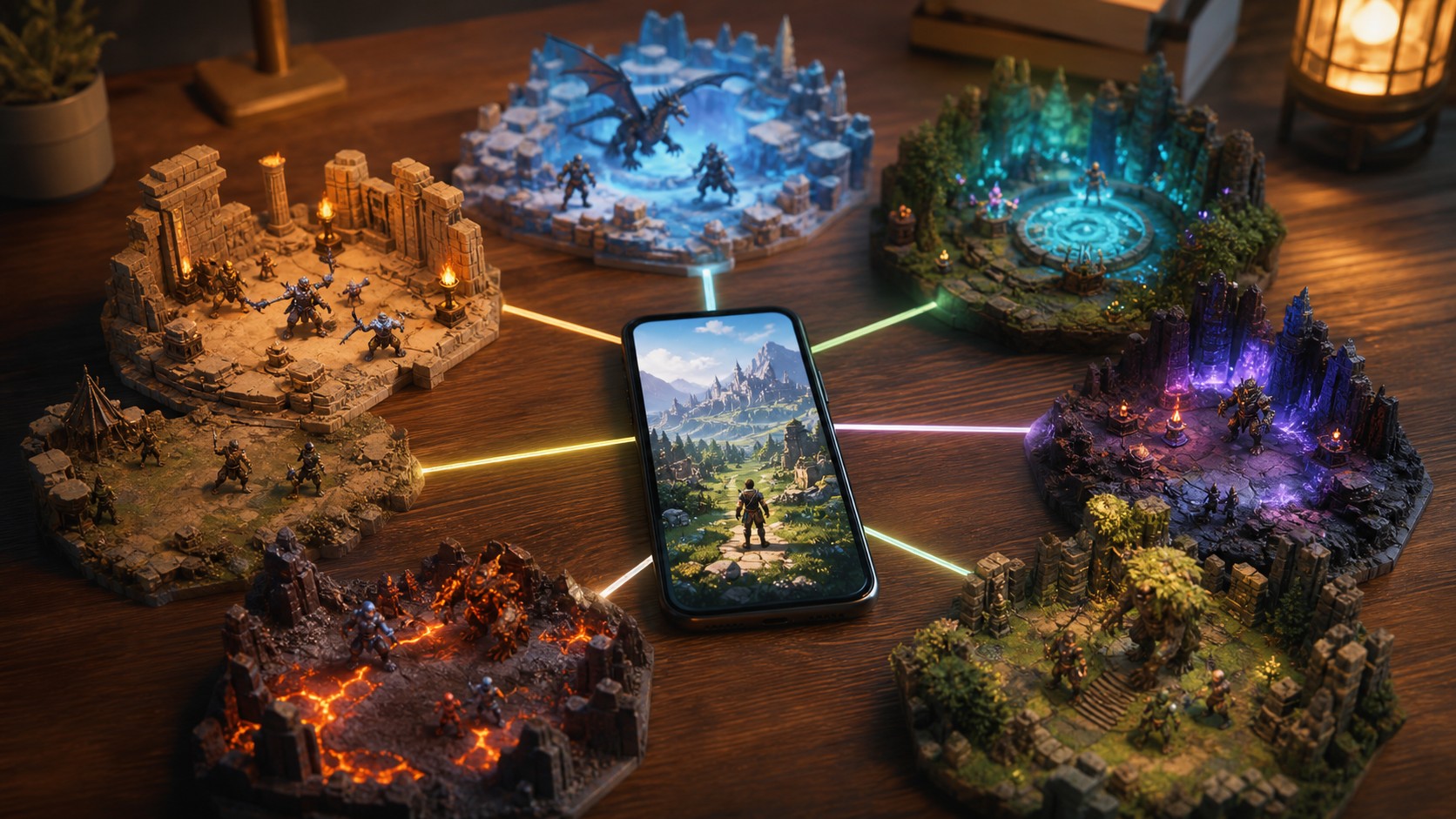
For years, mobile games were defined by convenience rather than complexity. They were quick sessions on small screens, filled with tap mechanics and predictable patterns. Non-playable characters, or NPCs, existed mostly as scripted signposts. They delivered quest text, repeated canned dialogue, and reset their behavior after every interaction. They were functional but forgettable. That era is ending. AI NPCs on mobile are now crossing a threshold where characters genuinely feel alive. Advances in on-device processing, cloud inference, machine learning optimization, and behavioral modeling have converged to create something unprecedented: dynamic characters capable of memory, adaptation, and unscripted conversation. The phone in your pocket is now powerful enough to support believable personalities that respond to how you play, what you say, and the choices you make. This shift is not incremental. It is transformational. For the first time in mobile gaming history, players are not just navigating worlds. They are forming relationships within them.
A: Practically endless through adaptive generation, though technically finite.
A: No—AI augments creativity rather than replacing it.
A: Personalized systems often improve long-term engagement.
A: Yes, but privacy-focused models can protect users.
A: AI reduces repetition by adapting in real time.
A: Yes, with dynamic narrative engines.
A: Hybrid cloud-edge systems are most effective.
A: Performance constraints exist but are improving.
A: Yes, if developers prioritize transparency.
A: Increasingly immersive, adaptive, and near-limitless mobile experiences.
The Technology Behind Living Characters
At the heart of this revolution lies artificial intelligence tailored specifically for mobile hardware. Traditional NPCs relied on branching dialogue trees and rule-based scripts. Modern AI NPCs use natural language models, behavioral AI systems, and contextual data layers to generate responses dynamically rather than pulling from pre-written lines. Mobile devices now incorporate neural processing units designed to accelerate AI workloads. Combined with cloud-assisted computation, these processors allow characters to interpret player actions, analyze in-game context, and produce unique responses in real time. Compression techniques and optimized inference models make it possible to run surprisingly sophisticated systems without draining battery life or overheating devices. Contextual awareness is another major leap. AI NPCs track location, quest progress, relationship history, and player tendencies. If you frequently take diplomatic approaches, characters begin to treat you as a negotiator. If you lean toward aggression, rumors spread. Dialogue shifts organically because the AI connects data points rather than flipping simple boolean switches. What feels like personality is actually layered simulation. Memory modules, emotion-state variables, and probabilistic decision-making systems work together to create emergent behavior. The illusion of life becomes stronger because the system is no longer following a static script.
Real-Time Dialogue and Emotional Intelligence
One of the most visible breakthroughs in AI NPCs on mobile is dynamic conversation. Instead of tapping through fixed options, players can increasingly engage in free-form dialogue powered by conversational AI. This dramatically changes immersion. A shopkeeper can react to your recent victory. A rival can reference your earlier betrayal. A companion can express concern if you take reckless risks. The tone and vocabulary shift depending on context. Even pauses and pacing can feel natural. Emotional modeling plays a crucial role. NPCs now operate with simulated emotional states that influence behavior. An insult may lower trust and increase hostility. A kind gesture may open new storylines. Over time, relationships evolve in subtle ways, reflecting patterns rather than isolated decisions.
On mobile platforms, these systems are designed with efficiency in mind. Lightweight sentiment analysis and intent recognition enable meaningful interaction without requiring massive server loads. As a result, AI NPCs can feel surprisingly nuanced, even within the constraints of mobile architecture. Players no longer feel like they are talking to a vending machine of dialogue options. They feel heard.
Persistent Memory: The Secret Ingredient
Memory is what truly makes AI NPCs feel alive. Traditional mobile characters forgot everything as soon as a quest ended. Modern AI-driven NPCs maintain persistent data about your interactions. They remember favors. They recall insults. They track promises. This persistence deepens immersion because it mirrors human social dynamics. When an NPC references something you did hours earlier, it creates continuity. The world feels less like a stage and more like a living ecosystem.
Developers achieve this by storing compressed behavioral logs tied to player profiles. On-device caching ensures responsiveness, while cloud syncing maintains continuity across sessions. The key innovation is selective memory. NPCs do not need to remember everything. They remember what matters emotionally and narratively. This selective recall creates the illusion of depth without overwhelming system resources. It is efficient, elegant, and transformative.
Adaptive Behavior and Emergent Gameplay
Beyond dialogue, AI NPCs on mobile now adapt their behavior to player strategies. Enemy units may learn your combat habits and counter them. Allies might reposition intelligently based on your movement patterns. Civilians in simulation games respond to economic changes and social policies in unscripted ways. Adaptive AI adds unpredictability. No two playthroughs are identical because NPC decisions are influenced by probability models and evolving player data. This introduces emergent storytelling, where dramatic moments arise naturally rather than from pre-scripted cutscenes.
Mobile hardware once struggled to handle complex AI systems. Today’s optimization techniques allow for scalable intelligence levels. NPC complexity can dynamically adjust based on device capability, ensuring performance remains smooth while maintaining behavioral depth. The result is a more organic experience. Players feel challenged, surprised, and emotionally invested.
Why Mobile Is the Perfect Platform
It might seem surprising that mobile is leading this transformation, but the platform has unique advantages. Mobile devices are personal. They are used daily, often in short bursts. This frequency of interaction makes persistent AI relationships more impactful. When you return to a game multiple times per day, NPC continuity feels meaningful.
Cloud integration is seamless on mobile networks. Real-time AI updates, live behavioral tuning, and event-driven content can be deployed quickly. Developers can refine NPC personalities based on aggregated anonymized data, improving realism over time. Touch interfaces also contribute. Gestures, camera inputs, and voice recognition add layers of interaction beyond button presses. AI NPCs can respond to tone of voice or player pacing, making the experience even more immersive. Mobile gaming is no longer casual filler. It is a primary entertainment medium, and AI NPC technology reflects that evolution.
The Rise of Procedural Storytelling
AI NPCs on mobile are fueling a new era of procedural storytelling. Instead of following rigid narrative paths, stories emerge from interactions between AI-driven characters and player decisions. This approach reduces content bottlenecks. Developers no longer need to script every potential outcome manually. Instead, they build systems that generate believable outcomes based on variables.
For players, this means stories feel personal. Two users playing the same mobile game may experience completely different narrative arcs because their relationships, reputations, and choices differ. Procedural storytelling also extends replayability. Returning to a game does not mean repeating the same events. It means discovering new interactions and alternate outcomes shaped by AI.
Monetization Without Breaking Immersion
AI NPCs on mobile also influence monetization strategies. Personalized character arcs can encourage engagement without feeling intrusive. Instead of generic prompts, NPCs might organically introduce optional side stories or cosmetic upgrades aligned with your relationship history. This approach feels integrated rather than disruptive. When monetization is woven into narrative context, it supports immersion rather than shattering it. The key lies in balance. Ethical AI design avoids manipulation while enhancing engagement. Transparent mechanics and meaningful rewards ensure players feel respected, not exploited.
Technical Challenges and Ethical Considerations
While AI NPCs on mobile represent remarkable progress, challenges remain. Data privacy is critical. Systems that track behavior must safeguard player information rigorously. Latency is another concern. Real-time AI interactions require careful optimization to prevent lag. Hybrid approaches, blending local inference with cloud computation, mitigate this issue.
There are also ethical questions surrounding emotional simulation. When NPCs convincingly express affection or distress, designers must consider psychological impact. Responsible design ensures immersion does not cross into manipulation. Industry standards are evolving rapidly to address these concerns. Transparency, user consent, and robust encryption are becoming foundational principles in AI-driven mobile development.
The Competitive Advantage for Developers
Studios that successfully implement AI NPC systems gain a significant competitive advantage. Player retention improves when characters feel meaningful. Engagement metrics rise when conversations feel unique. AI-driven NPCs also reduce repetitive content creation. Developers can focus on worldbuilding and system design rather than scripting thousands of dialogue lines. Scalability becomes possible. Smaller teams can produce expansive-feeling worlds because AI fills in behavioral depth dynamically. The mobile gaming market is crowded. AI NPC innovation offers differentiation that goes beyond graphics and monetization models. It creates emotional attachment, which is far more powerful than visual fidelity alone.
The Future of AI NPCs on Mobile
Looking ahead, AI NPCs on mobile will likely become even more sophisticated. On-device AI acceleration will improve. Memory systems will grow more nuanced. Cross-game character continuity may emerge, where AI companions travel with players across titles. Augmented reality integration could blur the boundary between digital and physical spaces. AI NPCs might respond to your real-world location, time of day, or ambient conditions, creating hybrid storytelling experiences.
Voice-driven gameplay is also poised to expand. Conversational AI will feel increasingly natural, enabling fully voiced interactions that rival console experiences. As generative AI continues to evolve, NPCs may begin crafting their own subplots within developer-defined boundaries, adding layers of unpredictability while maintaining narrative coherence.
Why It Matters
The reason AI NPCs on mobile finally feel alive is not just technical. It is experiential. Human beings connect through conversation, memory, and emotion. When games simulate those elements convincingly, engagement deepens. Mobile gaming has matured from distraction to destination. AI NPC innovation marks a turning point where handheld devices host characters capable of surprising, adapting, and remembering. The illusion of life has always been the goal of game design. Now, with intelligent systems embedded into the devices we carry everywhere, that illusion feels closer than ever. We are no longer tapping through static scripts. We are stepping into evolving worlds filled with digital personalities that learn, respond, and grow alongside us. The future of mobile gaming is not just more powerful graphics or faster processors. It is believable characters powered by AI that make every session feel uniquely personal. And for the first time, they truly feel alive.