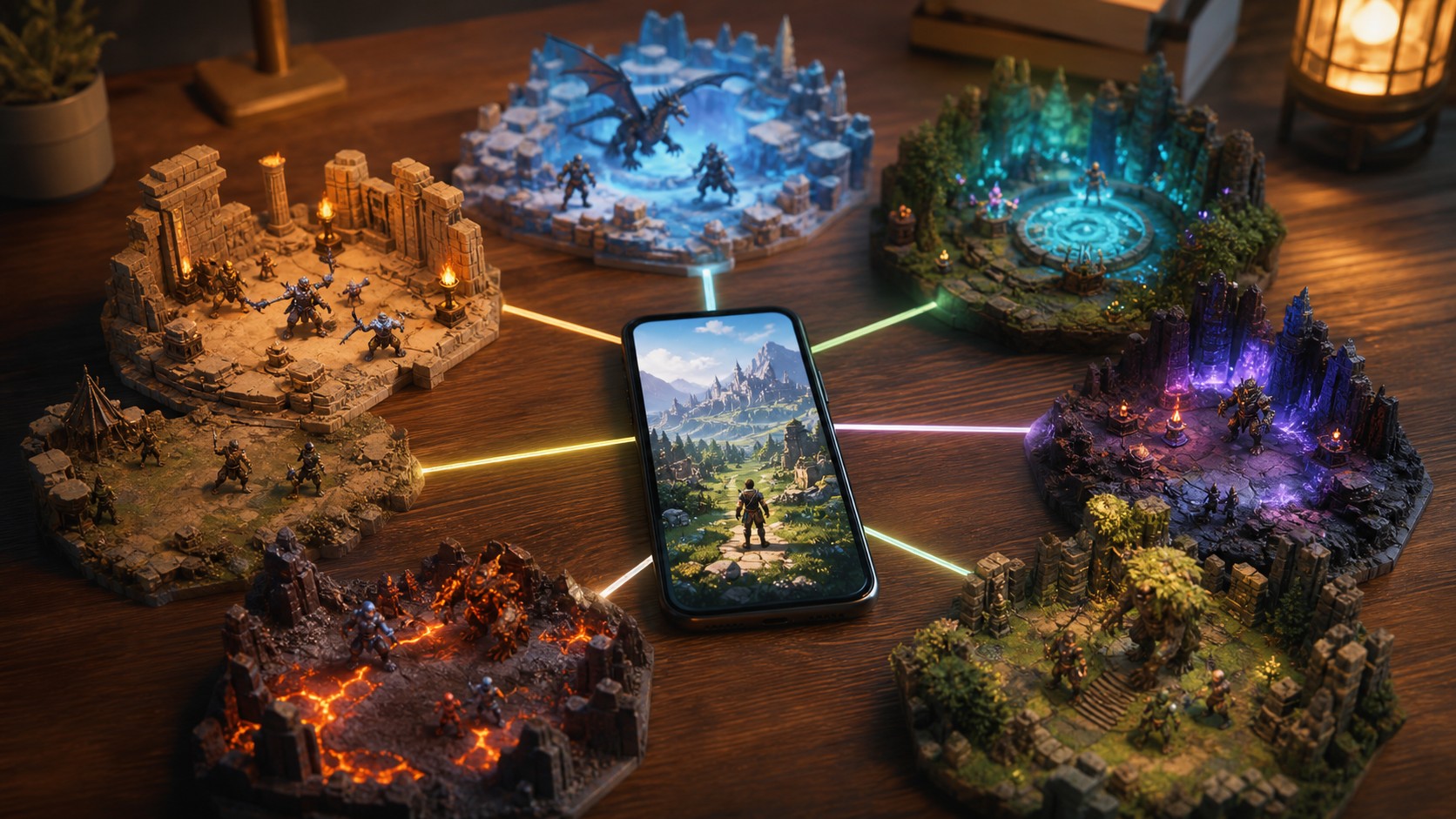
The New Era of Mobile Game Narratives
Mobile games used to be built around predictable loops: tap, collect, upgrade, repeat. Story was often a decorative layer placed on top of the gameplay, giving players a reason to chase coins, unlock characters, or clear another level. But the rise of AI-driven storytelling is changing that formula. Today, mobile games are beginning to feel less like fixed scripts and more like living worlds that can listen, adapt, and respond. AI-driven storytelling gives mobile games the power to create experiences that feel personal. Instead of sending every player through the same scenes, dialogue, and outcomes, AI can help shape unique journeys based on decisions, play style, character choices, emotional tone, and even the pace at which a player explores. The promise is simple but powerful: no two stories alike.
A: It is a narrative system that adapts dialogue, quests, characters, and consequences to each player’s choices.
A: Not when used well; writers set the world, tone, rules, and emotional direction while AI adds personalization.
A: Mobile players play in different session lengths, so adaptive stories can fit quick visits or longer adventures.
A: Yes, but the best systems vary the journey while preserving strong structure and story quality.
A: RPGs, mysteries, romance games, life sims, strategy games, survival games, and interactive fiction all benefit strongly.
A: The game tracks past actions, relationship changes, promises, conflicts, and important story states.
A: No; strong AI storytelling uses rules, context, writer-approved boundaries, and continuity systems.
A: Yes, because players can return to explore new choices, relationships, conflicts, and endings.
A: Poorly controlled AI can create inconsistent characters, broken lore, repetitive dialogue, or unsatisfying story arcs.
A: It can make a mobile game feel personal, reactive, and alive, as if the story was built around the player.
Why Mobile Games Are Perfect for AI Storytelling
Mobile gaming is deeply personal. People play on their phones in short bursts, during commutes, late at night, between classes, or while relaxing at home. Because mobile games fit into daily life so naturally, they are ideal for stories that adapt to the player rather than demanding that the player adapt to the game. AI storytelling can respond to these habits. A player who checks in for five minutes might receive a quick character message, a bite-sized quest, or a small narrative twist. A player who settles in for an hour might unlock deeper dialogue, longer missions, or emotional character arcs. This flexibility makes AI-driven mobile storytelling feel more human, more responsive, and more connected to the rhythms of real life.
From Branching Paths to Living Stories
Traditional branching stories are impressive, but they are still limited by prewritten paths. A developer might create three endings, five relationship routes, or ten major choices, but every possible outcome must be planned in advance. AI-driven storytelling opens the door to something more fluid. It allows stories to shift dynamically, not just branch at obvious decision points.
In an AI-enhanced mobile game, a side character might remember that the player ignored them several chapters ago. A rival might become more aggressive if the player keeps winning through deception. A village might change its attitude based on how the player solves problems. These moments can make the world feel alive because the story is not simply waiting for the next scripted scene. It is reacting to the player’s history.
Personal Choices That Actually Matter
Players love the feeling that their choices matter, but many games only create the illusion of consequence. A dialogue option may change a line or two, but the story often returns to the same main road. AI-driven storytelling can make choices feel more meaningful by tracking patterns over time instead of treating each decision as isolated.
For example, if a player consistently shows mercy, the game can generate storylines where enemies begin to question their loyalty, allies trust the player more deeply, or certain conflicts resolve without combat. If a player acts selfishly, the game might create suspicion, betrayal, or opportunities for darker alliances. The best AI storytelling does not just ask, “What did the player choose?” It asks, “What kind of person is the player becoming inside this story?”
Characters That Remember the Player
One of the most exciting uses of AI in mobile game storytelling is character memory. Instead of repeating generic dialogue, non-player characters can respond to what the player has done, how they speak, what they value, and how their relationships have changed. This can turn simple mobile interactions into surprisingly emotional experiences.
Imagine a fantasy mobile RPG where a companion remembers the first item you gave them, the battle where you saved them, or the promise you failed to keep. Imagine a detective game where suspects adjust their behavior based on your interrogation style. Imagine a cozy life sim where villagers notice your routines and slowly form opinions about you. AI memory can transform characters from scripted tools into believable personalities.
Procedural Story Worlds With Emotional Direction
Procedural generation has been used in games for years to create maps, loot, dungeons, and enemy encounters. AI-driven storytelling brings procedural systems into the emotional and narrative side of the game. Instead of only generating where the player goes, the game can help generate why the journey matters. This does not mean replacing writers with random story machines. The strongest approach combines human-authored themes, worldbuilding, character foundations, and narrative rules with AI systems that customize the experience. Writers create the soul of the world. AI helps that world respond in fresh ways. The result is a story that still has artistic direction, but feels personal every time it unfolds.
Mobile RPGs and the Rise of Dynamic Quests
Role-playing games are one of the clearest homes for AI-driven storytelling. Mobile RPGs thrive on progression, character development, factions, gear, and long-term player investment. AI can use those systems to generate quests that feel connected to the player’s actual journey.
A player who frequently uses stealth might receive missions from a secretive guild. A player who favors healing magic might be drawn into a plague storyline. A player who collects rare artifacts might trigger a treasure-hunter rivalry. Dynamic quests can make the game feel as if it is watching the player’s style and building adventures around it, rather than delivering the same content to everyone.
AI Storytelling in Mobile Mystery Games
Mystery games are especially exciting for AI-driven storytelling because they depend on uncertainty, clues, suspicion, and discovery. A traditional mystery has fixed answers. Once a player solves it, much of the surprise disappears. AI can help create mysteries where details change, suspects behave differently, and evidence appears in new combinations.
This can give mystery mobile games tremendous replay value. One player might uncover a betrayal through a hidden letter. Another might solve the case by noticing a character’s inconsistent behavior. A third might be misled by false clues generated by a rival. When handled carefully, AI can make mystery games feel less like puzzles with one answer and more like investigations with living consequences.
Romance, Friendship, and Relationship Systems
AI-driven storytelling can also reshape mobile games built around romance, friendship, and social simulation. These genres depend on emotional connection, and AI can make relationships feel less mechanical. Instead of simply raising a friendship meter with gifts, players could build relationships through tone, timing, shared history, and meaningful choices.
A character might become distant if the player only visits when they need something. Another might open up after repeated acts of kindness. A romantic storyline might evolve differently depending on whether the player is bold, cautious, playful, or protective. This creates a deeper sense of intimacy because the relationship feels shaped by behavior, not just by selecting the correct dialogue option.
The Power of Replayability
Replayability is one of the biggest advantages of AI-driven storytelling in mobile games. When no two stories are exactly alike, players have a stronger reason to return. They may replay to see how a different personality changes the story, how a new alliance affects the ending, or how the world responds to a completely different strategy. For mobile game developers, this can increase long-term engagement without relying only on grind, daily rewards, or endless content drops. Players return because they are curious. They want to know what else the world can become. That curiosity is powerful because it comes from story, not just mechanics.
Player Identity and Personalized Adventures
Great games often let players express identity. They choose a class, customize an avatar, name a team, decorate a home, or decide how to solve problems. AI-driven storytelling can expand that identity into the narrative itself. The story can begin to reflect who the player is inside the game world.
A brave player might become known as a fearless protector. A clever player might gain a reputation as a strategist. A chaotic player might become a wildcard that factions either fear or admire. When the narrative reflects the player’s identity, the game becomes more than entertainment. It becomes a personal legend that feels different from anyone else’s.
The Role of Human Writers in AI-Driven Games
AI storytelling works best when it supports human creativity rather than replacing it. Writers still matter deeply. They define the world’s tone, emotional stakes, lore, moral conflicts, character voices, and dramatic structure. Without human direction, AI-generated stories can feel hollow, inconsistent, or unfocused.
The future of mobile storytelling is likely to be a collaboration. Writers build the narrative framework, design the key characters, create the major arcs, and establish what the story is about. AI then helps personalize the spaces between those anchors. It can vary dialogue, generate side stories, adjust pacing, and respond to player behavior while staying within the creative boundaries set by the development team.
Balancing Freedom and Story Quality
One of the biggest challenges of AI-driven storytelling is balance. Too much control can make the story feel scripted. Too much freedom can make it feel messy. Players want stories that respond to them, but they also want satisfying arcs, memorable characters, and meaningful conclusions. Mobile games need AI systems that understand tone, pacing, stakes, and continuity. A dramatic betrayal should not happen randomly just because the system can generate one. A character should not change personality from scene to scene. A quest should not contradict the world’s rules. The magic of AI storytelling depends on making the story feel free while still feeling carefully crafted.
Ethical Storytelling and Player Trust
AI-driven storytelling also raises important questions about trust. If a game adapts emotionally to a player, developers must be careful about how that adaptation is used. Personalized storytelling should make the game richer, not manipulative. Players should feel respected, not exploited.
This is especially important in mobile games, where monetization systems can already be aggressive. AI should not be used to pressure players into purchases through emotional targeting or unfair difficulty adjustments. The best AI-driven storytelling will be transparent, player-first, and designed to deepen immersion rather than manipulate behavior.
The Technology Behind Adaptive Storytelling
AI-driven storytelling can involve several connected systems. Natural language models can help generate dialogue variations. Narrative engines can track player decisions and story states. Recommendation systems can choose which quests or character moments fit a player’s current journey. Procedural generation can create locations, encounters, or conflicts that align with the player’s style.
The strongest systems combine these tools carefully. The game might use structured rules to protect continuity, writer-approved templates to maintain quality, and AI-generated variation to keep moments fresh. This layered approach helps avoid randomness while still allowing the story to feel alive.
How AI Can Improve Smaller Mobile Games
AI-driven storytelling is not only for massive studios. Smaller mobile game teams can use AI to create richer narrative experiences without building enormous content libraries by hand. A small studio might design a compact world with a few strong characters, then use AI systems to generate personalized side conversations, daily events, or branching quest details.
This could help indie mobile games compete with larger titles by offering deeper personalization. Instead of trying to outspend big studios on graphics or content volume, smaller teams can focus on emotional originality. A well-designed AI story system can make a modest game feel surprisingly expansive.
Genres That Could Be Transformed
AI-driven storytelling can influence almost every mobile game genre. Strategy games could create rival leaders who remember past wars and negotiate based on history. Survival games could generate personal hardships, moral dilemmas, and evolving community drama. Puzzle games could wrap challenges in changing story contexts that respond to progress.
Even casual games could benefit. A match puzzle game might feature a town that grows differently for each player. A farming game might create seasonal festivals based on player relationships. A card battler might develop rivalries around the decks a player uses most often. AI storytelling does not have to be complex to be effective. It simply needs to make the player feel seen.
The Future of No Two Stories Alike
The future of mobile game storytelling is not just bigger worlds. It is more responsive worlds. Players will expect games that remember them, challenge them personally, and surprise them with stories that feel handcrafted. AI-driven storytelling points toward a future where mobile games are not only played but lived through in unique ways.
No two stories alike does not mean every moment must be randomly generated. It means every player’s journey can carry a different emotional fingerprint. The same kingdom, mystery, romance, or battle can unfold through different choices, relationships, consequences, and memories. That is where the excitement lies.
Why This Matters for Players and Developers
For players, AI-driven storytelling can make mobile games more meaningful. It can turn quick sessions into personal chapters and long campaigns into unforgettable journeys. It can make characters feel closer, choices feel heavier, and replaying feel worthwhile.
For developers, it offers a new creative frontier. The goal is not simply to add AI because it is trendy. The goal is to build stories that feel more alive than traditional systems allow. When done well, AI-driven storytelling can create mobile games that are flexible, emotional, surprising, and deeply replayable.
Final Thoughts
AI-driven storytelling in mobile games is still evolving, but its potential is enormous. It can change how players experience choice, character, memory, and consequence. It can help games become more personal without losing structure, more replayable without feeling repetitive, and more emotional without relying on one fixed script. The most exciting mobile games of the future may not be the ones with the longest scripts or the biggest worlds. They may be the ones that feel like they were listening all along. In those games, every player carries a different story in their pocket, and every return opens the door to something new.