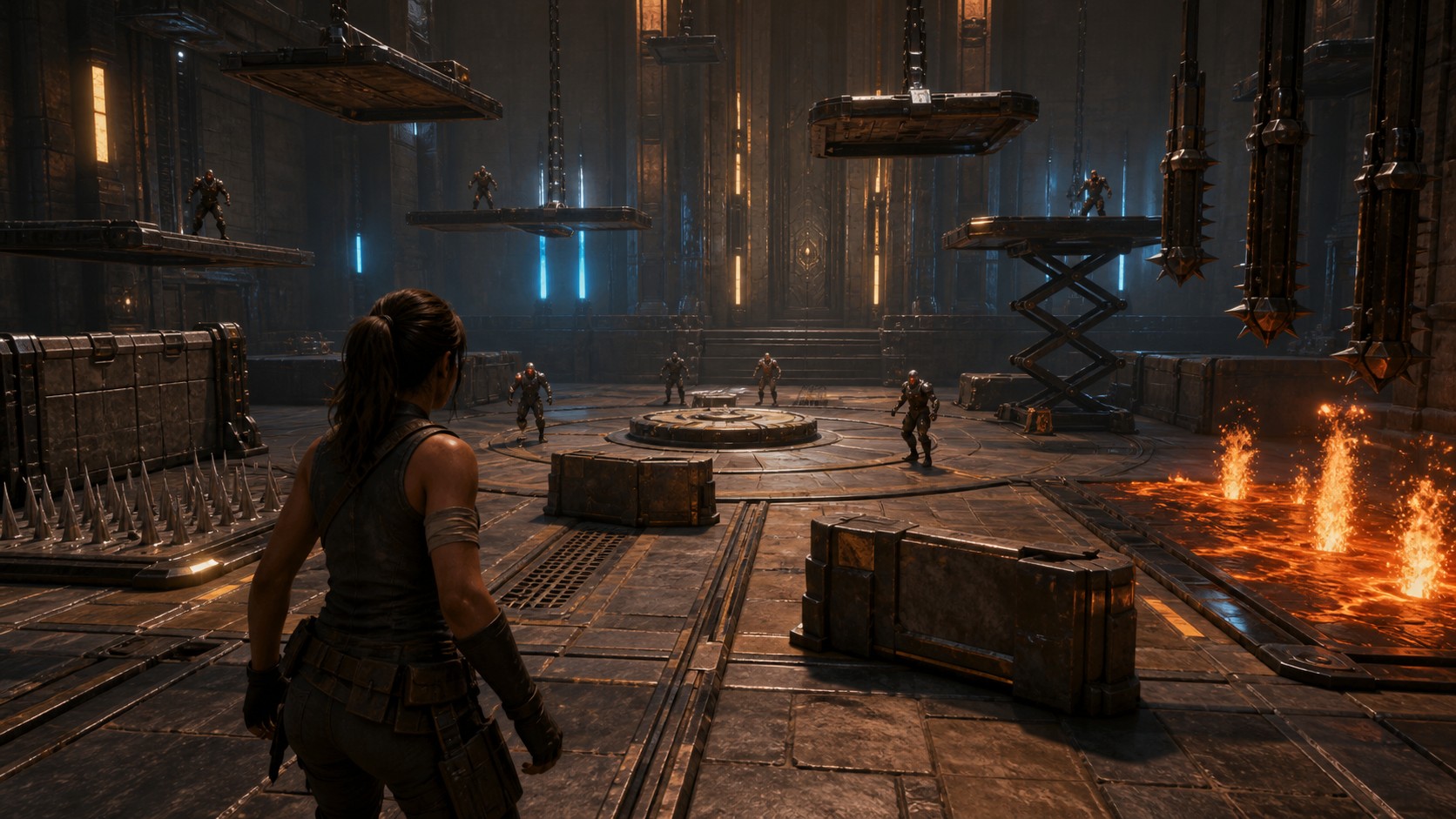
A Definition Built Around What Changes
Dynamic difficulty adjustment, usually shortened to DDA, is a game’s automatic modification of challenge in response to information gathered during play. The defining feature is the response: something about the current or later challenge changes because of observed play or player state. A game that becomes harder at level ten is not necessarily using DDA; that increase may happen identically for everyone. A game that selects a gentler encounter after a pattern of failed attempts is a clearer example. The adjustment can be numerical, structural, or informational, and it need not use machine learning. It can also be visible or quiet, temporary or persistent, broad or limited to one activity. Those distinctions matter because the same label covers very different experiences. Establishing a precise vocabulary makes it easier to understand settings, evaluate design claims, and decide whether an adaptive mode fits the kind of challenge you want.
A: The game selects challenge changes during play in response to relevant information.
A: No. It can operate between encounters, attempts, stages, or other defined boundaries.
A: Not necessarily. Scaling may follow character progression without evaluating experienced challenge.
A: They can when the game adjusts their availability or specificity in response to play.
A: No. An unchanged random selection rule can produce varied runs without any feedback.
A: Yes, if its definition permits adaptation within a demanding operating range.
A: No. Keeping competitors close can conflict with rewarding strong performance.
A: A modified practice condition should not be confused with a fixed-condition comparison.
A: No. Explicit preferences and accessibility needs still require dependable controls.
A: Identify the input, response, timing, limits, and player-facing promise before judging the system.
The Minimum Ingredients of DDA
Three ingredients establish the basic idea: an observed condition, a decision rule, and an adjustable challenge. In a hypothetical racing game, the condition could be the player’s sustained distance from the leading pack. The rule could select a small change after that distance remains large for several checkpoints. The adjustable challenge could be the pace of computer-controlled rivals within an allowed range. Nothing in that sequence requires a learned model. Conversely, a neural network controlling a rival’s steering would not establish DDA if the challenge never responds to the player’s performance or state. Intelligence in an opponent and adaptation of difficulty describe different properties.
A Preset Is a Starting Contract
Traditional difficulty presets define a package of rules selected by the player. A hard preset might increase incoming damage, reduce supplies, enable additional enemy moves, or change several properties together. Those rules can remain fixed throughout the campaign. DDA instead selects adjustments during play. The two approaches can coexist: a preset can set the baseline and limits, while an adaptive system chooses an encounter variant inside those limits. Seeing both a difficulty menu and adaptive behavior is therefore not a contradiction in itself.
The important question is whether the menu explains that relationship. If hard means fixed enemy damage but variable encounter pressure, the description should not imply that every run presents identical conditions. If a challenge mode disables adaptation, that distinction should be explicit too. Players need not know the implementation formula to understand the agreement. They do need enough information to choose between consistency, responsiveness, and particular forms of assistance without discovering after a long campaign that their chosen mode meant something different from what they expected.
Difficulty options also include accessibility settings that do not fit neatly on an easy-to-hard scale. Holding instead of repeatedly tapping a button can remove a physical barrier while preserving tactical decisions. Larger subtitles can improve comprehension without altering an encounter. These settings should not require the player to demonstrate poor performance first. DDA may complement them, but it does not replace direct configuration. Defining the boundary prevents an adaptive feature from being presented as a universal solution for needs that deserve explicit, dependable controls.
Progression Is Not Automatically Adaptation
A campaign can introduce stronger enemies at a predetermined chapter, regardless of who is playing. That is authored progression. Another game can scale enemy statistics with the player’s character level according to a fixed formula. That is level scaling, which responds to a progression variable but does not necessarily estimate whether the player is struggling. Terminology varies, so it helps to describe the mechanism rather than argue from the label alone. Ask whether the adjustment responds to experience in the current task or merely follows the campaign’s published progression structure.
The distinction changes how players interpret improvement. In a fixed sequence, learning a move can produce an immediate advantage on the next attempt. In a level-scaled world, gaining equipment may be partly offset by stronger opponents. In a performance-adaptive encounter, a streak of successful attempts may invite more complex opposition. All three can be legitimate designs, but they make different promises about growth. Clear explanations should identify which variable drives change and which benefits of practice or progression remain available to the player afterward.
Consider two characters with identical levels and equipment who take very different numbers of attempts to finish an arena. A level-scaling formula can give them identical enemies because their progression states match. A performance-adaptive rule can select different later variants because their encounter histories differ. This comparison isolates the source of the difference without assuming either design is superior. It also shows why an item’s displayed level cannot reveal the whole difficulty policy. The game may apply progression scaling, performance adaptation, both, or neither, and those layers need separate explanations.
Design documents benefit from naming these layers independently. A tester investigating tougher enemies can then check the chapter table, character-level formula, and performance policy in turn. That prevents an ordinary progression change from being misdiagnosed as a broken adaptive response. It also makes player-facing descriptions more accurate: the game can explain that enemies scale with equipment while encounter composition remains fixed, or that performance changes encounter selection without altering character-level statistics.
Randomness Does Not Establish a Feedback Rule
Two runs can feel different simply because a game samples enemy positions, weather, or loot from the same probability distribution each time. That is variation, not necessarily DDA. Adaptation appears when observed play changes the selection process or its parameters. A hypothetical dungeon generator might always choose randomly among rooms, but exclude especially demanding room combinations after sustained resource depletion. The random selection and the adaptive constraint are separate mechanisms. This distinction explains why a lucky run cannot prove the presence of assistance and why a procedural game can still offer a fixed challenge distribution. Different outcomes alone do not reveal the rule producing them.
Adjustment Can Target More Than Combat
In an action game, difficulty might be changed through threat concurrency, recovery intervals, or available resources. A puzzle game has different controls: clue order, hint specificity, optional intermediate steps, or access to a partial demonstration. A strategy game could alter which authored scenario variant appears next while keeping unit rules stable. These changes do not share one numerical difficulty scale. Each intervenes in a particular demand, such as reaction speed, resource planning, inference, or coordination, and each can help one kind of player while disrupting another.
This is why a universal skill score can be misleading. Someone may aim accurately but lose track of objectives, or solve puzzles quickly while finding timed inputs uncomfortable. Increasing all dimensions together after one success can punish an unrelated weakness. A more targeted design looks for the specific bottleneck and limits the intervention accordingly. Even a simple system can distinguish repeated navigation mistakes from repeated combat deaths. The point is not to construct a complete psychological profile; it is to avoid treating every difficulty as the same problem.
An Attempt-Based Example From Beginning to End
Suppose a fictional platform game contains a checkpoint followed by a moving platform sequence. The game records whether an attempt reaches the middle platform and where a fall occurs. After several failures at the same transfer, it offers an optional practice variant with a longer pause at that platform. The destination, jump controls, and route remain unchanged. The relevant response is not merely that the player receives another attempt; it is that the timing challenge is modified because a specific pattern of failures has been observed.
A careful implementation separates learning assistance from record conditions. The practice variant could display its status and avoid submitting its completion time to a fixed-rule leaderboard. The player could return to the original timing after learning the route, or continue with assistance as an accepted campaign option. This protects comparison without treating assisted play as worthless. The system has two legitimate goals: enable progress in the main experience and preserve a clearly defined test for people who want to measure performance under unchanged conditions.
The same example also exposes possible mistakes. Counting every fall as evidence for timing trouble could misclassify a player who is exploring an alternate path. Activating help after one attempt could interrupt productive experimentation. Removing all pauses after one assisted success could create a jarring reversal. The decision needs enough evidence, the intervention needs a relevant mechanism, and the return policy needs restraint. DDA is therefore not just the moment difficulty changes; it includes the rules governing observation, permission, duration, and eventual withdrawal of the change.
Rubber Banding Is a Particular Kind of Response
Rubber banding commonly describes mechanisms that help trailing competitors catch up or restrain leaders so a contest remains close. In racing, that might involve computer-controlled pace changes tied to gaps in the field. It can overlap with DDA, but closeness and appropriate challenge are not identical goals. A close race can feel unfair if strong driving never creates a lasting lead. A challenging race can remain satisfying even when the field spreads out. When evaluating a system, ask whether it adapts to support a player’s learning, preserve dramatic proximity, or manage something else entirely. Those objectives can produce similar surface effects while rewarding performance differently.
When Responsiveness Becomes a Bad Fit
Fixed conditions matter when a game’s appeal depends on studying the same problem repeatedly. Speedrunning, score comparison, and deliberate boss practice benefit from stable rules and clearly identified variants. An adaptive system can still exist elsewhere in the game, but its boundaries need to be visible. Otherwise a better time might reflect a gentler encounter rather than a better route. The issue is not that adaptive play lacks value; it is that comparison requires agreement about which conditions are held constant and which differences are part of the competition.
Adaptation can also weaken motivation if success immediately triggers a compensating penalty. Imagine saving resources through careful play only to receive fewer resources until the savings disappear. That can make good decisions feel futile. Designers can avoid this by protecting earned advantages, adapting encounter composition instead of every outcome, and allowing pressure to remain low sometimes. A responsive game does not need to cancel every benefit the player creates. Preserving the consequences of planning is often more important than maintaining a perfectly narrow band of moment-to-moment challenge.
Read the Setting as a Set of Permissions
The most useful way to read an adaptive option is to ask what it authorizes the game to do. Does it select future encounters, alter enemy statistics, offer hints, or restore resources? Does it act only after failure, or can successful play raise pressure? Can it change during a boss attempt? These questions translate a vague feature name into practical expectations. A short description that answers them is more informative than claiming that the game will always find the player’s perfect difficulty through advanced intelligence.
Players can then choose based on purpose rather than status. Someone returning after a long break may welcome a responsive campaign while keeping a favorite challenge arena fixed. Another player may prefer manual settings because they want a stable reference for improvement. Neither preference is inherently more authentic. The right option depends on whether the session is about exploration, mastery, social play, narrative progress, or a particular test. DDA is a design tool serving those purposes, not a replacement for deciding what the game is trying to provide.
A precise definition keeps both enthusiasm and criticism grounded. DDA is automatic challenge adjustment driven by information from play; it is not synonymous with procedural generation, smart enemies, accessibility, or a changing campaign. Its quality depends on the evidence it uses, the properties it changes, and the promises it preserves. Once those details are known, the label becomes less mysterious. You can evaluate the actual experience: whether its responses help you learn, whether its rules remain understandable, and whether it respects the challenge you chose to undertake.