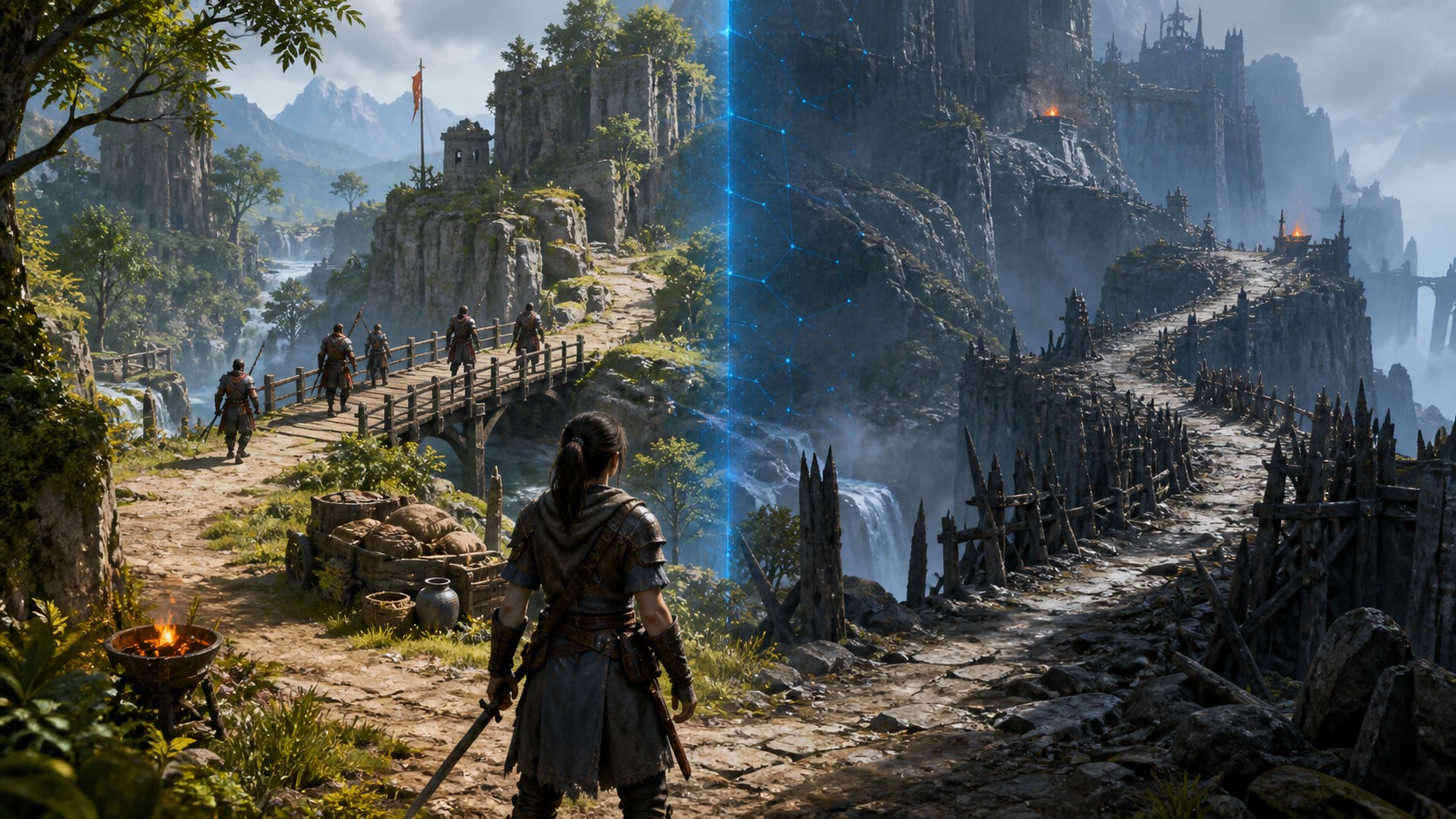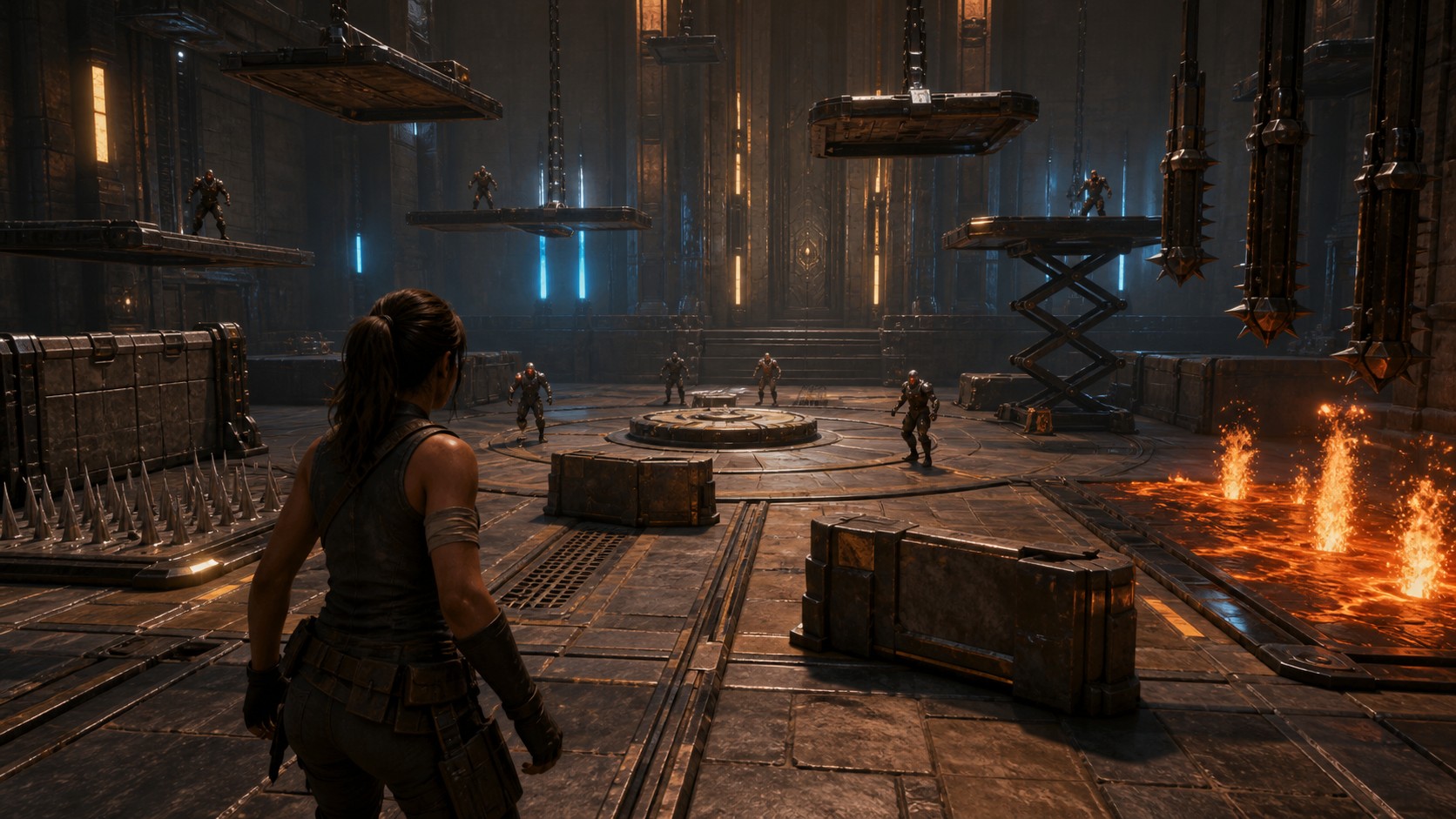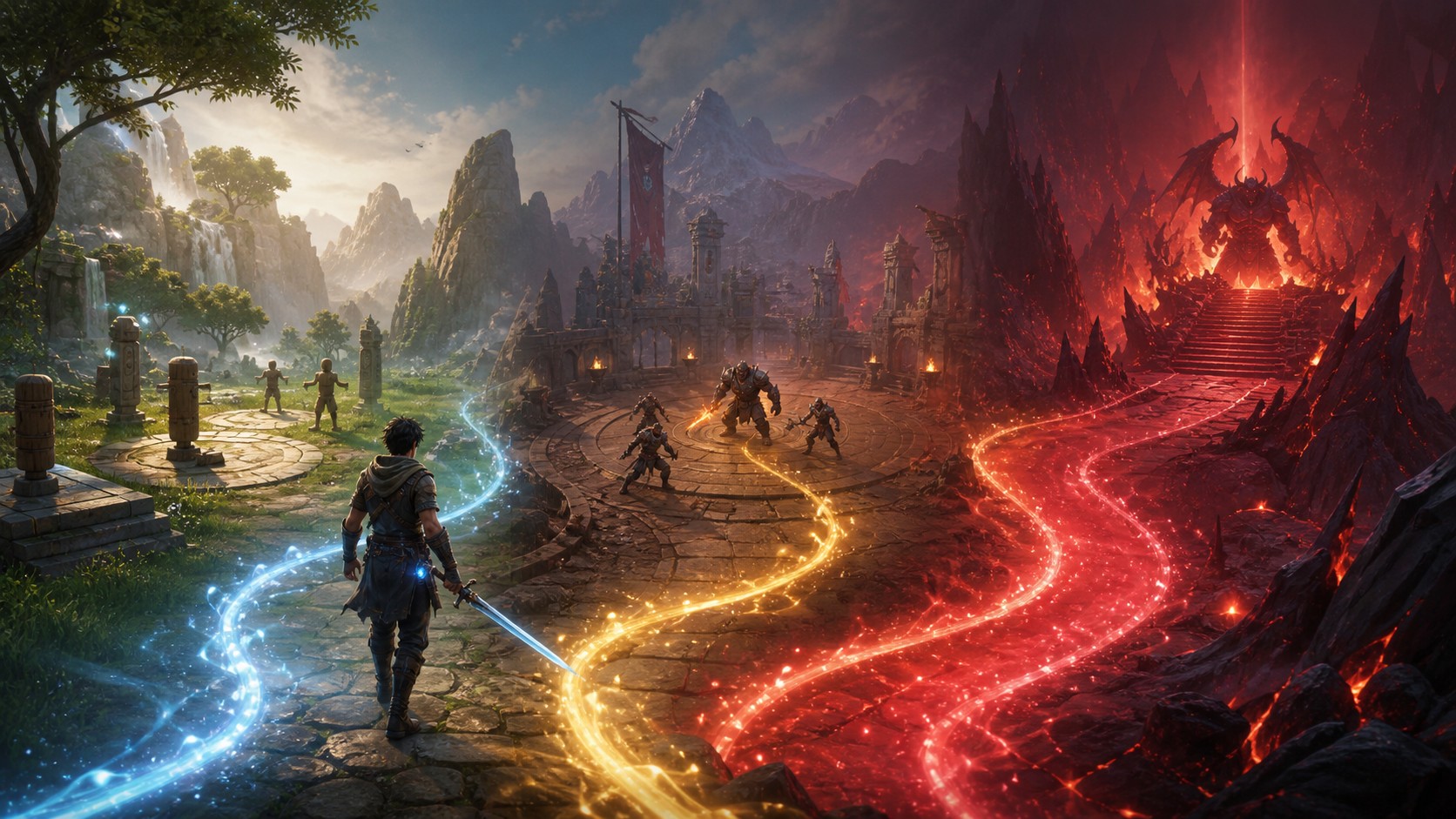
The Challenge Is a Feedback Loop
Imagine entering a combat arena with three healing charges, missing several shots, and escaping with almost no health. The next arena looks familiar, yet its reinforcements arrive a little later. An adaptive difficulty system could produce that difference by observing the first encounter, estimating how much pressure it created, and selecting a permitted adjustment before the next encounter begins. Understanding that sequence is more useful than picturing an invisible opponent that knows exactly how you feel. These systems work with incomplete evidence, limited control over game rules, and decisions made by designers long before your session started. Some use straightforward thresholds; others use statistical models or learned predictions. Their shared engineering problem is to change the challenge without making practice pointless or the world inconsistent. Following the feedback loop from observation to verification reveals both the appeal of adaptive difficulty and the reasons it can fail.
A: No. Thresholds, counters, and authored selection rules can implement the feedback loop.
A: It is the logic that converts observations and estimates into permitted difficulty changes.
A: Smoothing reduces reactions to isolated results that may not represent a sustained problem.
A: Different switching thresholds prevent small fluctuations from repeatedly toggling a difficulty state.
A: It can target observable conditions associated with tension, not directly measure a player's feelings.
A: They allow adjustments without changing the rules of an action already underway.
A: No. Supplies can accumulate and alter later encounters or progression economies.
A: Relevant observations, the estimated state, the chosen intervention, and its timing.
A: No. Testing must also examine learning, predictability, satisfaction, and differences between players.
A: The protected rules depend on the game, but players need reliable cues and meaningful consequences.
Start With What the Game Can Observe
A controller cannot directly measure confidence, enjoyment, or understanding. It can record events such as damage received, resources spent, retries, completion time, and successful defensive actions. In a hypothetical arena game, those events might be summarized after each encounter rather than evaluated after every bullet. This gives the controller a useful unit of experience: one reasonably complete attempt at a recognizable problem. The choice of unit matters because a difficult opening exchange can otherwise look like a failed encounter before the player has had time to recover.
Measurements need context before they become evidence about difficulty. Low accuracy means something different for a weapon that suppresses groups than for a single-shot precision weapon. A long completion time might indicate cautious exploration, not an inability to win. Designers can separate travel time from combat time and compare performance only across compatible equipment or encounter types. Even then, the observations remain imperfect. Good systems preserve that uncertainty instead of treating every recorded statistic as a precise description of the person holding the controller.
A useful telemetry record also distinguishes opportunity from outcome. Counting successful dodges without counting incoming dodgeable attacks rewards players who simply encountered more attacks. Recording both creates a rate that is easier to interpret. The same principle applies to healing, parrying, puzzle hints, and navigation errors. These denominators are not glamorous, but they prevent the adaptive layer from reacting to differences in exposure as though they were differences in skill. Better observations often improve a controller more than a more complicated prediction algorithm would.
Estimate Pressure Without Pretending to Read Minds
The next stage combines observations into an estimate of current challenge. A designer might assign more importance to repeated deaths than to ammunition use, then smooth the resulting value across several encounters. Smoothing means a single unusual result contributes less than an established pattern. For example, one disastrous fight after an equipment change need not erase an hour of competent play. The estimate can also include a confidence value, allowing the controller to make smaller adjustments when it has little relevant evidence about the current situation.
Skill and pressure are related but different quantities. A skilled player can face high pressure because the encounter is deliberately demanding, while an inexperienced player can feel comfortable in a forgiving room. A useful design therefore evaluates the relationship between the player, their tools, and the present task. It need not assign a permanent skill rank. Local estimates are often sufficient: this player is currently consuming resources faster than this section replenishes them. That statement supports a practical intervention without claiming to describe their overall ability.
Choose a Target That Leaves Room for Drama
Adaptive difficulty needs a target, but a target does not have to mean constant comfort. An action game might aim for encounters that consume meaningful resources while avoiding long sequences of unrecoverable failures. A horror game might deliberately alternate vulnerability with brief relief. Those intentions should be encoded as acceptable ranges and encounter phases, not one universal score. Otherwise the controller can flatten the very contrasts that make the experience interesting, treating every tense moment as a defect and every relaxed moment as an invitation to escalate.
Consider a boss designed to test a newly introduced defensive move. If the controller optimizes only for quick victories, it may remove the attacks that provide opportunities to practice that move. The player progresses, but the lesson disappears. A better target includes the learning objective: preserve enough readable attacks to practice, limit overwhelming combinations, and allow recovery between attempts. This is why difficulty adaptation belongs inside encounter design rather than being added as a generic slider after the encounters are already complete.
Targets should also respect the player’s declared preferences. Someone who selected a demanding mode may accept repeated failure as part of the appeal. Someone who enabled generous checkpoints may want the same mechanical challenge with less repeated travel. These are different requests, even when both players die equally often. Explicit settings can define the controller’s operating envelope, while observed behavior refines decisions within it. The resulting contract is clearer than assuming the system may revise any rule whenever its internal performance estimate changes.
Map the Estimate to Specific Game Controls
The controller can change only the variables developers expose. Possible controls include reinforcement delay, ammunition supply, enemy aggression, attack combinations, checkpoint placement, or the number of simultaneous threats. These controls are not interchangeable. Raising enemy health lengthens exposure to danger, while delaying a reinforcement wave creates breathing room without changing the existing enemies. Designers should identify the immediate consequence of each control and its downstream effects on pacing, resources, and player learning before allowing the adaptive layer to select it automatically.
A practical implementation can use a small menu of authored encounter variants. The controller selects a variant whose pressure fits the estimated need, and the encounter system handles its ordinary execution. This avoids generating arbitrary mixtures that were never tested together. A harder variant might add a flanking route while retaining the same attack timing and damage rules. A gentler variant might reduce concurrent attackers. Such bounded choices preserve a coherent game vocabulary and make debugging more tractable than unrestricted changes to dozens of numerical values.
Keep the Controller From Oscillating
A poorly tuned feedback loop can alternate between excessive punishment and excessive rescue. The player struggles, the controller lowers pressure sharply, the player wins easily, and the controller immediately raises it again. This oscillation does not require machine learning; simple rules can produce it. One remedy is to limit the size of each adjustment. Another is to require several compatible observations before reversing direction. The goal is to make changes proportional to the evidence rather than proportional to the emotional drama of the latest result.
Separate thresholds can prevent constant switching near a boundary. For instance, a hypothetical pressure estimate might need to rise above a high threshold before assistance increases, but fall below a lower threshold before assistance is withdrawn. The gap is called hysteresis. It means small fluctuations around one value do not repeatedly toggle the state. A cooldown can add another restraint by requiring the controller to wait through an encounter before making another decision. Both techniques help create continuity without requiring a sophisticated model.
Timing is part of stability too. Changing attack speed halfway through a familiar animation undermines the timing the player is practicing. Selecting the next encounter variant at a doorway gives the world a cleaner transition. Resource adjustments can happen at established supply points rather than appearing whenever health falls. These boundaries reduce contradictory feedback: the player can still form expectations about the current fight, even if the broader campaign responds to their performance. A stable controller protects those expectations as deliberately as it regulates average difficulty.
Account for Delayed Consequences
An adjustment can solve the immediate problem while creating another one several rooms later. Extra ammunition may make the current encounter comfortable, but it can also let the player stockpile enough supplies to trivialize the next chapter. Increasing enemy durability might consume that stockpile, yet it also changes weapon feel. Designers need to inspect these delayed effects across a sequence, not merely check whether the next fight was won. Campaign economies, upgrade systems, and checkpoint rules can all amplify a small local decision over time.
One approach is to separate temporary relief from permanent progression. A replenishment point can restore a minimum usable loadout without granting extra upgrade currency. An encounter can offer more recovery space without changing the equipment earned afterward. These choices preserve the campaign’s longer trajectory while addressing an immediate bottleneck. They still need testing for exploitation and unintended loops. The important engineering question is not just whether a control reduces pressure, but where its effects stop and whether later systems assume a different resource state.
Test the Entire Loop, Not Just Its Formula
Validation begins with recorded sessions and deliberately constructed edge cases. Testers can feed the controller examples of sudden improvement, repeated intentional failure, unusual weapons, long pauses, and returning players. The output should remain within its allowed bounds and should change for understandable reasons. Logging the selected action alongside the observations and estimate makes those reasons inspectable. Without that trace, a frustrating encounter can be blamed on adaptation even when the real cause is a spawn bug, a balance change, or ordinary variation.
Human playtesting then checks what numbers cannot establish by themselves. Can players still recognize improvement? Do encounter transitions feel coherent? Does assistance remove the exact obstacle they wanted to master? Completion rates can help identify bottlenecks, but they cannot answer those questions alone. A controller that raises completion while making victories feel unearned may be succeeding at the wrong objective. Interviews, replay review, and optional player feedback can expose that mismatch before a promising metric becomes an unquestioned design requirement.
Testing should include a fixed-difficulty baseline using the same content. Otherwise any improvement might come from better checkpoints or clearer attack cues rather than adaptation itself. Compare similarly situated players and inspect where the benefit appears, not just the overall average. Some groups may gain while others lose predictability. The point is not to prove that adaptation always wins. It is to establish the circumstances in which this particular controller helps, and to retain a reliable alternative when its assumptions do not fit the player.
A Good Loop Makes Its Limits Visible
Players do not need a live dashboard of every internal estimate, but they benefit from knowing the kind of experience they selected. A settings description can explain whether encounters respond to performance, which broad properties may change, and whether the mode can be disabled. Designers can also preserve a fixed challenge option for comparison or deliberate mastery. That transparency turns adaptation into a supported play style rather than a secret claim that the software understands the player better than the player understands their own preferences.
The strongest adaptive difficulty systems are therefore constrained feedback systems with an artistic purpose. They observe imperfect signals, choose modest interventions, wait for consequences, and preserve the rules that make learning possible. Machine learning can contribute to estimation or prediction, but it does not replace those design decisions. When evaluating an adaptive game, ask what is measured, what can change, when it changes, and what remains protected. Those four questions reveal much more about the experience than the presence of an AI label on its feature list.