Small Changes Live Between the Big Moments
The most noticeable difficulty changes announce themselves with tougher enemies or larger damage numbers. Subtler ones alter the space around those events: how long you can breathe before another attack, whether a supply cabinet restores a usable loadout, or how many opponents are allowed to engage at once. A game can feel more manageable without making any individual enemy obviously weaker. It can also become harder while preserving the same weapons, animations, and visible rules. That does not establish that a particular game is secretly adapting; ordinary encounter scripting and random variation can create similar impressions. But examining the mechanisms shows how an adaptive layer could operate beneath the surface. The useful distinction is between changing what the player has learned and changing the circumstances in which that knowledge must be applied. Quiet assistance tends to feel most coherent when it works on those circumstances and leaves recognizable actions intact.
A: Yes. Timing, coordination, resources, routes, and information can change the demands of play.
A: No. Fixed placement and ordinary random drops can also produce useful supplies.
A: It is permission for an enemy to perform an action within a limited concurrency budget.
A: No. A fixed input buffer is a usability mechanic regardless of player performance.
A: Consistent weapon behavior helps players understand their actions and recognize improvement.
A: Yes. An imperceptible clue may fail to address the misunderstanding causing the blockage.
A: Not necessarily. Plausible supply points and encounter transitions can preserve continuity better.
A: Teammates can have conflicting needs, positions, and roles within the same encounter.
A: A single play sequence rarely separates adaptation from scripting, chance, and player improvement.
A: It supports the central activity, preserves dependable feedback, and matches the player's selected mode.
The Empty Second Before Reinforcements
Picture a fictional warehouse fight with an initial patrol and a second group waiting behind a loading door. A pressure manager could delay the second group until the first confrontation has settled. During that delay, the player reloads, checks a flank, and notices a healing pickup. No damage value needs to change. The adjustment affects overlap: two manageable problems stop arriving at the same time. Because the pause occurs within a plausible encounter rhythm, the player may experience it as ordinary pacing rather than as explicit help.
Making that same fight harder can mean reducing the separation between groups, but there are limits. Sending the second group before the player has any readable warning can convert pressure into an ambush with no useful response. Designers can protect a minimum cue duration and a viable route out of the opening position. The adaptive variable then controls how much preparation is available beyond that minimum. This preserves the essential promise that attentiveness and positioning matter, even when the encounter asks for faster decisions.
A Crowd That Does Not Attack All at Once
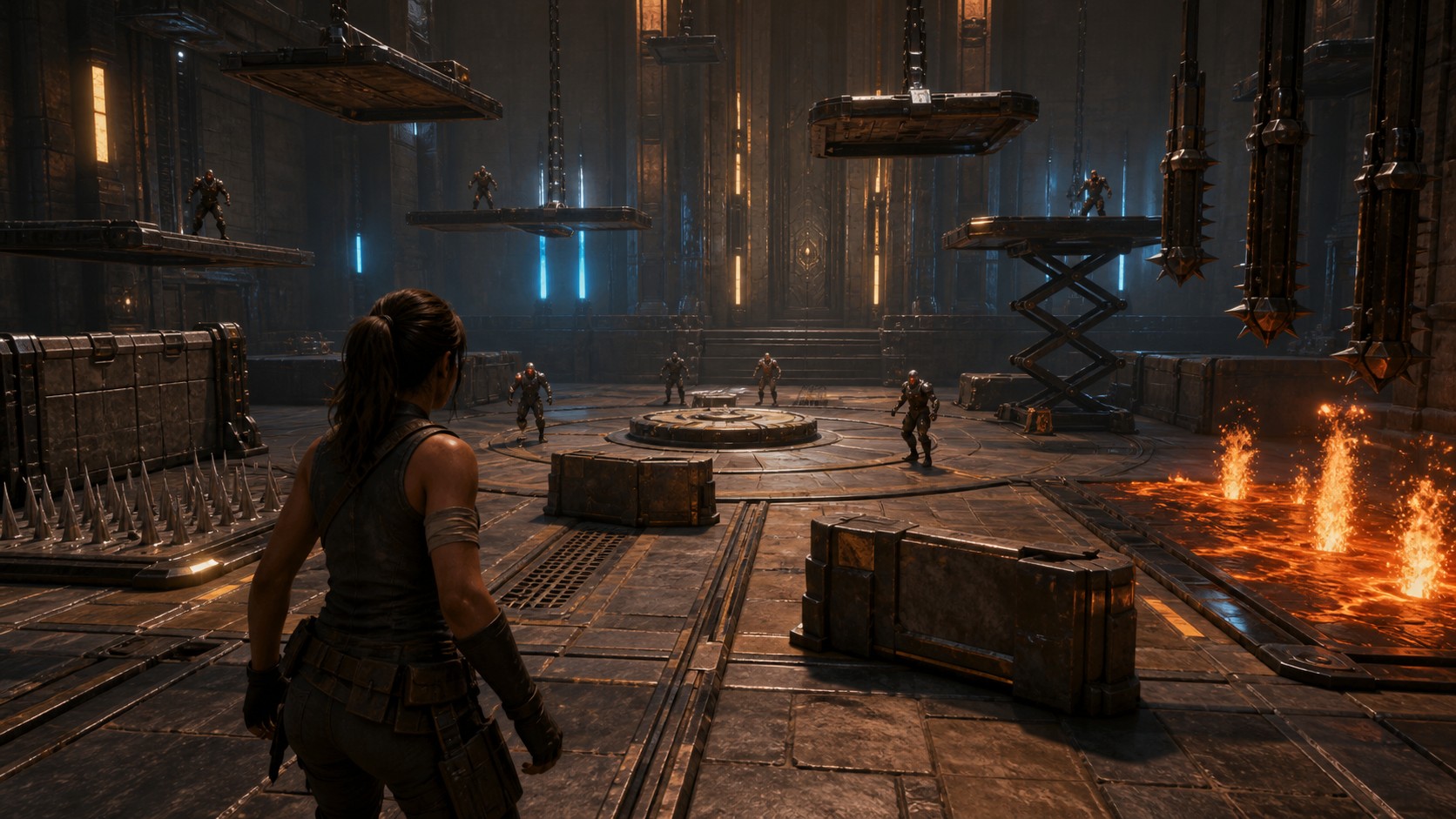
A room may contain six enemies while only a few are permitted to begin major attacks simultaneously. One way to implement this is an attack-slot system: an enemy requests permission, uses a slot during its committed action, and releases it afterward. Others reposition, threaten, or wait. If an adaptive manager changes the number of available slots between combat phases, it changes the player’s decision load without deleting enemies from the room. The visible crowd remains intimidating while the actual sequence stays within a manageable range.
The waiting behavior must still make sense. Enemies that stand motionless in clear view advertise the scheduling mechanism and can make the player feel patronized. Repositioning behind cover, maintaining distance, or preparing a clearly signaled attack provides a believable reason for delay. Those behaviors can be entirely rule-based. Calling them AI describes their decision logic, not evidence that they learned from a database of human play. Adaptation sits above those local decisions, adjusting the budget within which individual enemies perform their existing roles.
Attack slots also illustrate why apparent ease can be deceptive. The player may improve at interrupting enemies, naturally reducing simultaneous pressure without any adaptive intervention. Alternatively, a fixed encounter script may reserve attacks for dramatic beats. A video of one unusually calm fight cannot distinguish these explanations. To identify genuine adaptation, someone would need controlled comparisons or reliable information from the developers. The mechanism is worth understanding, but understanding it should not become a license to diagnose invisible systems from every fortunate moment.
Supplies Can Support Recovery Without Becoming Gifts
A supply point can respond to inventory rather than award a fixed quantity. Imagine a cabinet that brings ammunition up to a minimum usable amount, with a cap that prevents stockpiling. A nearly empty player receives enough for another attempt; a well-equipped player gets little or nothing. If the minimum depends on recent struggle, the cabinet becomes an adaptive control. If it is always the same minimum, it is simply a resource-balancing rule. Both can create the impression of timely generosity, but only the first necessarily changes in response to performance.
This technique becomes less convincing when the resource does not match the obstacle. Extra bullets will not help someone who cannot identify a boss’s vulnerable phase, and more healing can merely prolong a confusing encounter. The game may need clearer feedback or a better checkpoint instead. Supply adjustments are most defensible when the immediate bottleneck really is resource exhaustion. Designers should inspect failed attempts before choosing relief, because a subtle intervention that misses the cause can leave players stuck for longer without making the problem easier to understand.
Resource rules also need to account for voluntary scarcity. A player might save ammunition for an optional challenge, carry a weapon they do not intend to use, or deliberately attempt a low-resource run. Looking only at an empty magazine cannot distinguish those choices from an accidental shortage. A mode setting that disables adaptive replenishment preserves that style of play. Within an assisted mode, a supply floor can remain modest and tied to the next mandatory task, so help creates another opportunity rather than a large economic advantage.
Pickup presentation adds a separate constraint. If a cabinet visibly contains three cartridges before interaction, awarding twelve without explanation contradicts the object the player inspected. An inventory-sensitive container can instead use a consistent abstract presentation or show the final contents when opened. The rules then remain visually coherent even though the amount varies. Quiet adaptation depends on that cooperation between resource logic and presentation, not merely on choosing an appropriate quantity in the background.
Mercy at the Edge of an Action
Some forgiving mechanics operate around an input boundary rather than changing the world. A jump buffer can remember a jump pressed shortly before landing, while a short grace window can accept a jump shortly after leaving a ledge. These are often fixed usability rules, not adaptive difficulty, and should not be mislabeled. A hypothetical adaptive version could widen a permitted window after repeated timing failures, but that raises a learning question: which timing will the player expect next time? For subtle assistance to remain useful, it must preserve understandable relationships between the button press, animation, and result. If those relationships drift unpredictably, players may stop trusting their own feedback even when their success rate rises. Keeping a chosen tolerance stable for the rest of a platforming sequence can make its consequences easier to learn. If the game later offers to restore the original window, doing so at a practice boundary gives the player a meaningful choice rather than an unexplained change beneath the same familiar animation.
Route Pressure Instead of Touching Enemy Health
An encounter’s geometry can change its demands as much as its damage values. A flanking route forces the player to divide attention, while a protected fallback position allows a slower reset. In a modular arena, the designer could author several spawn routes and let a manager choose among them before combat starts. Selecting a less exposed approach changes the opening problem while retaining the enemies’ familiar durability. The player’s weapon therefore continues to behave as expected, which helps preserve a sense of mechanical consistency across different encounters.
Geometry is a dangerous place for improvisation if the game has not prepared alternatives. Spawning an enemy directly behind the camera may technically raise pressure but remove meaningful counterplay. Closing a route mid-escape can invalidate a decision made seconds earlier. A bounded system selects only tested routes and respects visibility, audio cues, and navigation constraints. The adaptive layer should work with the map’s authored possibilities. It should not be allowed to invent a spatial disadvantage that the level never taught the player to anticipate.
The timing of route selection also matters for cooperative play. One teammate may be low on resources while another is deliberately moving ahead. A manager that responds only to the weakest local state can make the whole encounter feel disconnected from the team’s actions. Looking at group separation, available rescue paths, and shared objectives gives a more relevant picture. Even then, a route adjustment should preserve ways for different roles to contribute, rather than quietly converting every fight into the same centrally clustered encounter.
Help Can Be Information, Not Extra Power
A puzzle game can reduce difficulty by changing when it supplies information. After several distinct unsuccessful interactions, it might emphasize a relevant object or offer an optional hint. This does not require solving the puzzle for the player. A useful first hint narrows attention; a later one can explain a relationship; an explicit solution remains a separate choice. The adaptive decision concerns when to offer the next level of information, while the hints themselves remain authored to preserve the puzzle’s logic and intended revelation.
Silence is ambiguous, however. A player who pauses may be thinking productively, studying an image, or discussing the puzzle with someone else. Offering hints based only on elapsed time can interrupt that process. Counting repeated ineffective actions gives a different signal, but exploration also includes harmless experiments. An optional prompt lets the player decide whether help is welcome. Subtlety should not mean forcing information into view before consent, especially when seeing the crucial clue is an irreversible change to the experience.
Why You Might Not Notice the Adjustment
Players usually attend to goals and immediate threats, not statistical properties of several encounters. A modest change in reinforcement spacing can disappear inside natural variation in movement, weapon choice, and enemy positioning. The player also changes during the same period. They may learn a route, relax their grip, or discover a useful attack. These overlapping causes make an adaptive intervention hard to isolate even when it exists. Not noticing therefore does not necessarily mean the developer used a deceptive or unusually sophisticated technique.
There is also a difference between invisible implementation and undisclosed rules. A game may openly say that encounter pressure responds to performance without announcing each individual adjustment. That is compatible with a natural experience. Conversely, a game can hide a very simple rule and create a genuine trust problem if it promises a fixed challenge. The relevant question is what expectations the interface establishes. A quiet system should still be explainable at the level that affects mode selection, achievements, and comparisons between players.
Overcorrection makes the mechanism easier to feel even when its details remain obscure. Alternating effortless victories with abrupt punishment suggests that the game is chasing recent outcomes too aggressively. Repeatedly surviving on the last possible hit can feel suspicious if it erases consequences that otherwise seem reliable. Restraint helps: smaller adjustments, slower reassessment, and protected rules give ordinary performance variation room to exist. The system’s purpose should be to support the experience, not to make every encounter land on the same dramatic ending.
Notice the Boundary Between Support and Substitution
Subtle assistance works best when the player still solves the central problem. More breathing room can help someone practice target selection; an optional clue can help them see a relationship they then apply. But automatically eliminating the target or revealing the full answer substitutes an outcome for the activity. That may be appropriate in an explicitly selected skip or story mode, yet it serves a different purpose. Designers should identify the skill an encounter is meant to exercise and avoid quietly removing it while claiming to preserve the challenge.
For players, the practical response is to judge the experience by both comfort and consistency. Are failures understandable? Do learned timings remain dependable? Can assistance be configured when preferences change? Those questions are more useful than trying to detect a hidden adjustment from one unusually generous pickup. Games can alter challenge through timing, coordination, resources, geometry, and information, with or without learned models. The best subtle systems leave those mechanisms in service of a recognizable game rather than making the player feel that every result was selected in advance.